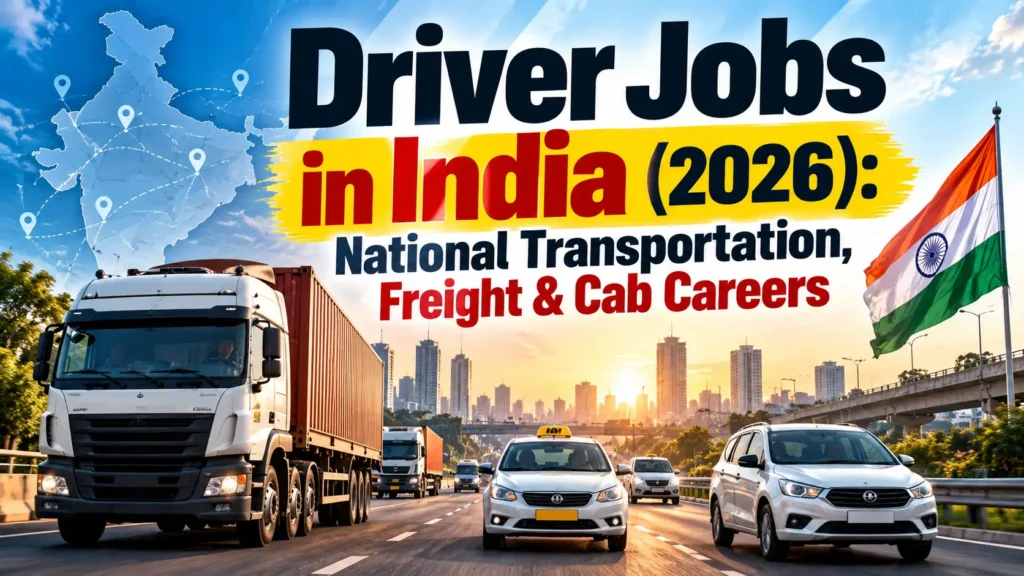
The transportation and logistics industry represents the indispensable circulatory system powering India’s multi-trillion-dollar economy. Moving over four billion tons of freight and hundreds of millions of passengers across national highways, state expressways, and urban arterials daily, seeking driver jobs in India and commercial transportation careers offers unmatched employment stability, nationwide geographic mobility, and competitive income potential. As industrial production scales, e-commerce reaches rural taluks, and urban corporate mobility expands, professional drivers remain among the country’s most essential economic contributors.
India’s commercial driving ecosystem encompasses diverse vehicle categories and employment models. From heavy multi-axle freight trucks navigating the Golden Quadrilateral and dedicated freight corridors to intra-city electric delivery vans, corporate employee transport cabs, luxury tourist coaches, and private executive chauffeurs, millions of livelihoods are anchored behind the wheel. The sector has transitioned from an informal, unorganized trade into a structured, technology-driven profession governed by digital tolling, satellite GPS tracking, and formal statutory labor protections.
Under regulatory frameworks administered by the Ministry of Road Transport and Highways (MoRTH) through the Central Motor Vehicles Rules and automated national portals, driver licensing, vehicle safety standards, and road infrastructure have modernized rapidly. Examining the primary industry sectors, licensing classifications, compensation scales, and professional career ladders provides commercial drivers and newcomers with a complete guide to long-term success.
1. Macro Industry Landscape: The Expanding World of Indian Transportation
The Indian transportation sector is undergoing a massive golden age of infrastructure modernization. The rapid construction of world-class access-controlled expressways (such as the Delhi-Mumbai Expressway and Bengaluru-Chennai Expressway) combined with multi-modal logistics parks has slashed transit dwell times and dramatically boosted commercial freight volumes. This infrastructure expansion has created an acute, nationwide shortage of skilled, disciplined professional drivers.
Commercial driving in India is broadly segmented across three macro sectors: Long-Haul Inter-City Freight (heavy commercial trucks, container trailers, refrigerated reefers, and bulk petroleum tankers), Intra-City Logistics & Quick Commerce (light commercial vehicles, electric delivery vans, and courier tempos), and Passenger Mobility (state road transport corporations, private luxury intercity buses, app-based cab fleets, and private corporate car rentals).
Unlike traditional office jobs bound to specific cities, a commercial driving licence provides universal geographic flexibility. A professional driver licensed in Maharashtra or Uttar Pradesh can readily secure employment across industrial logistics hubs in Gujarat, Haryana, Tamil Nadu, or Karnataka, ensuring year-round employment security regardless of localized economic fluctuations.
2. Comprehensive Breakdown of Driver Licencing Categories and Pay Scales
To navigate driving careers in India, professionals must understand the formal licence categories defined under the Motor Vehicles Act and their corresponding industry salary benchmarks.
Compensation structures vary significantly based on vehicle weight class, cargo hazard levels, passenger responsibility, and geographical operating terrain. Heavy commercial vehicle drivers operating multi-axle trailers receive substantial trip mileage allowances and overnight batta on top of their fixed monthly salaries.
The structured comparison table below outlines the five primary driving licence categories in India, detailing authorized vehicle classes, minimum eligibility criteria, standard industry applications, and average monthly earnings.
| Licence Category | Authorized Vehicle Classes | Minimum Age & Criteria | Typical Employment Sector | Average Monthly Earnings | Primary Regulatory Prerequisite |
| LMV-NT (Non-Transport) | Personal cars, hatchbacks, sedans, private SUVs | Age 18+, basic driving school test | Private family chauffeur, executive driver | ₹18,000 – ₹28,000 + food | Clean driving record, personal car etiquette |
| LMV-TR (Transport / Commercial) | Taxis, app cabs, delivery vans, commercial LCVs | Age 20+, 1-year LMV experience | Corporate cabs, e-commerce vans, airport taxis | ₹22,000 – ₹35,000 + trip bonus | Commercial transport badge & police verification |
| HMV / HGMV (Heavy Goods) | Multi-axle trucks, 10-wheelers, container trailers | Age 20+, prior LMV licence, medical fitness | Long-haul interstate freight, 3PL logistics | ₹32,000 – ₹55,000 + trip batta | Heavy commercial vehicle training certificate |
| HPV / PSV (Heavy Passenger) | Intercity luxury buses, school buses, state transport | Age 20+, commercial passenger badge | State transport (KSRTC, MSRTC), private bus fleets | ₹28,000 – ₹48,000 + allowances | Stringent passenger safety & night driving audit |
| Hazardous Goods Endorsement | Petroleum tankers, chemical carriers, LPG trucks | Age 21+, HMV + specialized 3-day hazmat cert | Oil marketing PSUs (IOCL, BPCL), chemical freight | ₹40,000 – ₹65,000 + high-risk pay | Mandatory annual hazardous cargo safety renewal |
★ Verified Driving & Chauffeur Vacancies: Looking for high-paying driver jobs, corporate chauffeur vacancies, or commercial fleet positions? Explore verified driving opportunities on AlphaReach to connect with leading transport companies, corporate fleets, and logistics providers in your city.
3. The Technological Modernization of Indian Commercial Driving
Over the past decade, driving in India has transitioned from a manual, isolated occupation into a highly connected, technology-driven profession. Commercial vehicles are now outfitted with advanced telematics control units, satellite GPS transponders, and digital compliance hardware.
The nationwide rollout of electronic FASTag tolling has eliminated hours of idling at highway toll plazas, allowing drivers to maintain steady cruising speeds and higher daily mileage. Furthermore, government AIS-140 GPS standards ensure that commercial vehicles broadcast real-time location, speed diagnostics, and emergency SOS alerts directly to central fleet control towers.
Drivers utilize smartphone applications for digital consignment verification, turn-by-turn truck-specific GPS navigation (avoiding low bridges and vehicle-restricted city zones), and electronic Proof of Delivery (e-POD) capture. Far from diminishing the driver’s role, technology has elevated commercial drivers into tech-enabled logistics managers commanding smart mobile assets.
4. Working Conditions, Statutory Welfare, and Driver Social Security
Historically, commercial long-haul driving in India suffered from irregular hours, highway fatigue, and lack of social safety nets. Today, landmark labor and road transport reforms are actively transforming driver working conditions across the nation.
Leading logistics conglomerates and organized fleet operators enforce strict driver duty-hour regulations—mandating rest stops every four hours and limiting daily driving hours to prevent fatigue-induced highway collisions. Modern highway rest stops (Dhabas and Driver Amenity Centers) built along national expressways provide clean dormitory sleeping quarters, hot showers, subsidized meals, and secure truck parking.
Furthermore, formal commercial drivers employed by registered transport corporations receive statutory social security benefits under the Code on Social Security—including Employees’ Provident Fund (EPF), Employee State Insurance (ESIC) medical coverage, group accidental insurance policies, and annual festival bonuses. Registration on national labor portals guarantees access to welfare schemes and subsidized healthcare.
5. Career Pathways: From Apprentice Driver to Fleet Entrepreneur
A driving career in India offers an extraordinary, proven ladder of economic mobility. What begins behind the wheel of a light delivery tempo can realistically culminate in vehicle fleet ownership and successful transport entrepreneurship.
An ambitious professional typically starts as an Assistant Driver or Light Motor Vehicle delivery driver. By maintaining a clean driving record, learning vehicle mechanical maintenance, and upgrading their licence from LMV to Heavy Goods (HMV), drivers transition into lucrative long-haul trucking or corporate coach operations, doubling their monthly earning capacity.
Many experienced drivers leverage government micro-financing schemes (such as the Pradhan Mantri MUDRA Yojana) and commercial vehicle financing to purchase their own commercial vehicle, transitioning from salaried employee to independent Owner-Operator. From managing a single commercial truck, successful driver-entrepreneurs frequently scale into operating multi-vehicle fleets, proving that driving provides one of the most reliable wealth-building engines in the Indian economy.
★ Fast-Track Your Driving Career Today: Ready to kickstart or advance your commercial driving career with immediate onboarding, flexible routes, and weekly payouts? Apply as a verified transportation and delivery partner on AlphaReach today!
Frequently Asked Questions (FAQs)
What is the minimum age to get a commercial driving licence in India?
Under the Motor Vehicles Act, the minimum age to obtain a commercial transport driving licence (LMV-TR or HMV) is 20 years. Candidates must already possess a valid Light Motor Vehicle non-transport licence for at least one year and pass a certified medical fitness examination.
How much can a commercial truck driver earn in India?
Commercial heavy truck drivers operating interstate linehaul routes typically earn between ₹32,000 and ₹55,000 per month, composed of a fixed monthly base salary plus trip mileage batta, fuel efficiency incentives, and loading/unloading allowances.
What is a commercial driver badge and is it mandatory?
A commercial driver badge is an official identification issued by state transport authorities authorizing a driver to operate public service vehicles (taxis, auto-rickshaws, and passenger buses). It requires police background clearance and completion of passenger safety orientation.
How does FASTag benefit commercial drivers in India?
FASTag uses RFID technology to deduct toll payments automatically while the vehicle is in motion, eliminating long physical cash queues at toll plazas, reducing transit time, saving fuel, and creating transparent digital travel records.
Can a driver with an Indian licence drive abroad?
Yes. Indian driving licence holders can apply for an International Driving Permit (IDP) through their local RTO or the Parivahan portal. An IDP is recognized across over 100 countries (including the UAE, UK, US, and Australia) for up to one year.
Conclusion
Driver jobs in India represent the resilient backbone of national commerce, moving the goods, resources, and people that keep the world’s most vibrant economy progressing. With expanding expressways, modernized vehicle fleets, and rising statutory protections, the profession offers unmatched stability and dignified earnings.
By investing in driver training, upholding exemplary road safety discipline, and embracing modern vehicle telematics, professional drivers can achieve exceptional career longevity and financial prosperity. Take pride in the profession and drive the nation forward into a prosperous future.