In the gig delivery sector in 2026, incentives make the difference between an average income and a highly lucrative monthly payout. Many new delivery riders assume that their total weekly pay is solely determined by multiplying the number of orders delivered by a flat rate. However, modern logistics algorithms operate on dynamic milestone mechanics, where base pay only accounts for roughly 55% to 65% of your total earnings, with the remaining 35% to 45% unlocked through daily and weekly incentives.
Understanding how delivery partner incentive calculation works is essential for every rider looking to optimize their working hours. Platforms like Zomato, Swiggy, Zepto, Blinkit, and Porter set tiered targets (also known as touchpoints, touchstones, or order milestones). If you fall short by even a single order, your daily incentive slab drops significantly, directly impacting your net profitability.
In this comprehensive 2026 guide, we break down real-world incentive models with simple, transparent mathematical examples. You will learn how base pay, peak hour multipliers, weekend bonuses, customer rating criteria, and minimum login hour conditions work together to shape your final payout.
Core Components of a Modern Gig Delivery Rate Card
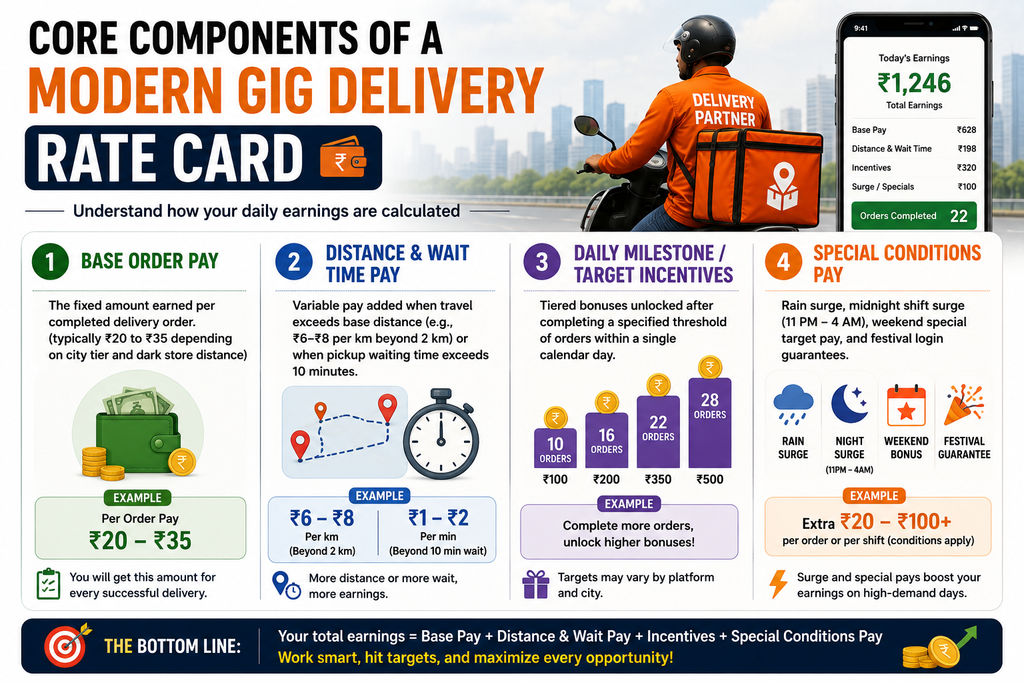
Before jumping into calculations, let us look at the four building blocks of a delivery partner’s daily pay slip:
- Base Order Pay: The fixed amount earned per completed delivery order (typically ₹20 to ₹35 depending on city tier and dark store distance).
- Distance & Wait Time Pay: Variable pay added when travel exceeds base distance (e.g., ₹6–₹8 per km beyond 2 km) or when restaurant/store pickup waiting time exceeds 10 minutes.
- Daily Milestone / Target Incentives: Tiered bonuses unlocked after completing a specified threshold of orders within a single calendar day (e.g., 10, 16, 22, or 28 orders).
- Special Conditions Pay: Rain surge, midnight shift surge (11 PM – 4 AM), weekend special target pay, and festival login guarantees.
Step-by-Step Earnings Example: A Full Day on the Road
Let us consider a real-world scenario of Rider Arjun, who works an 8-hour shift delivering grocery orders in a Tier-1 city. Let us calculate his daily earnings step-by-step:
Rider Shift Statistics:
- Total Orders Completed: 18 Orders
- Total Kilometers Traveled: 65 KM
- Base Pay per Order: ₹25
- Extra Distance Traveled (Beyond Base): 25 KM at ₹7/KM
- Peak Hours Worked: 4 Hours during Lunch & Dinner
Calculation Breakdown:
- Base Order Pay: 18 Orders × ₹25 = ₹450
- Distance Pay: 25 KM × ₹7 = ₹175
- Peak Hour Bonus: 8 Orders completed during peak hours × ₹15 = ₹120
- Gross Direct Pay (Before Target Incentive): ₹450 + ₹175 + ₹120 = ₹745
Now, let us apply the platform’s Daily Target Incentive Slab to Arjun’s shift.
> Discover high-paying delivery partner vacancies with structured bonus programs in your city. Compare active platform rate cards and choose the highest-earning routes near you.
Daily Milestone Incentive Slab Table (2026 Model)
| Order Milestone Slab | Orders Required | Min. Login Hours | Mandatory Peak Orders | Incentive Bonus (₹) |
| Tier 1 (Starter) | 6 – 9 Orders | 4.0 Hours | 2 Peak Orders | ₹75 |
| Tier 2 (Part-Time Pro) | 10 – 14 Orders | 6.0 Hours | 4 Peak Orders | ₹160 |
| Tier 3 (Full-Time Target) | 15 – 20 Orders | 8.0 Hours | 6 Peak Orders | ₹320 |
| Tier 4 (Super Rider) | 21 – 26 Orders | 10.5 Hours | 8 Peak Orders | ₹550 |
| Tier 5 (Weekend Mega) | 27+ Orders | 12.0 Hours | 10 Peak Orders | ₹850 |
Calculating Arjun’s Final Daily Pay & Net Profit
Since Arjun completed 18 orders with 8 hours of login and 8 peak orders, he successfully qualifies for Tier 3 (₹320 Incentive).
- Direct Earnings: ₹745
- Tier 3 Daily Incentive: ₹320
- Total Daily Gross Payout: ₹745 + ₹320 = ₹1,065
Deducting Operating Expenses (Fuel & Bike Maintenance):
- Petrol Consumed (65 KM at 45 KM/L = 1.44 Liters @ ₹102/L): ₹147
- Estimated Daily Bike Depreciation & Data: ₹35
- Arjun’s Net Take-Home Earnings: ₹1,065 – ₹182 = ₹883 for the day.
If Arjun works 26 days a month maintaining this tier, his gross monthly earnings reach ₹27,690, resulting in a net profit of approximately ₹22,950.
Critical Conditions Riders Must Meet to Unlock Incentives
Riders often complain that their incentives were cancelled despite completing the required number of orders. Fair labor frameworks and gig worker guidelines by the Ministry of Labour and Employment emphasize transparent contract terms. Always watch out for these strict app conditions:
- Order Acceptance Rate (Touchpoint Rate): You must maintain an acceptance rate above 90%–95%. Rejecting or missing 2 or more assigned orders can void your daily incentive.
- Order Cancellation Policy: Zero self-initiated order cancellations. Cancelling an order after accepting it drops your eligibility tier immediately.
- Mandatory Peak Hour Login: In almost all platforms, completing 18 orders during non-peak afternoon hours (2 PM – 5 PM) will not trigger high-tier incentives unless at least 6 to 8 orders are delivered during peak meal/grocery rush slots.
- Customer Rating Floor: Maintaining an average customer rating above 4.6 stars is mandatory on several premium delivery platforms.
Frequently Asked Questions (FAQs)
What happens if I deliver 14 orders when the incentive target is 15?
You will fall back to the Tier 2 slab (10–14 orders) and receive ₹160 instead of ₹320. Missing a milestone by even one order reduces your payout significantly, which is why monitoring your live in-app milestone tracker is crucial.
Are weekly incentives calculated separately from daily incentives?
Yes. Most platforms run weekly consistency bonuses (e.g., ₹1,200 to ₹2,500 extra) if you achieve daily targets for 5 or 6 consecutive days within the Monday-to-Sunday cycle.
Does rain surge count towards base pay or incentive?
Rain surge is usually added as direct order pay per delivery (₹15 to ₹35 per order) on top of your standard base pay and does not reduce your daily target milestone bonus.
Why was my incentive deducted due to ‘idle time’?
If you stay logged in but turn on battery saver or stay stationary outside high-demand hotspots without accepting orders, the algorithm flags low engagement and may disqualify your login hour quota.
> Boost your weekly earnings with daily milestone bonuses and peak payouts. Sign up as a verified delivery partner today and start earning on top gig platforms.
Conclusion
Mastering delivery partner incentive calculation empowers you to work smarter rather than just longer. By timing your shifts around peak demand windows, keeping your acceptance rate high, and targeting consistent daily milestones, you can maximize your hourly return and build a reliable, sustainable income in the gig economy.