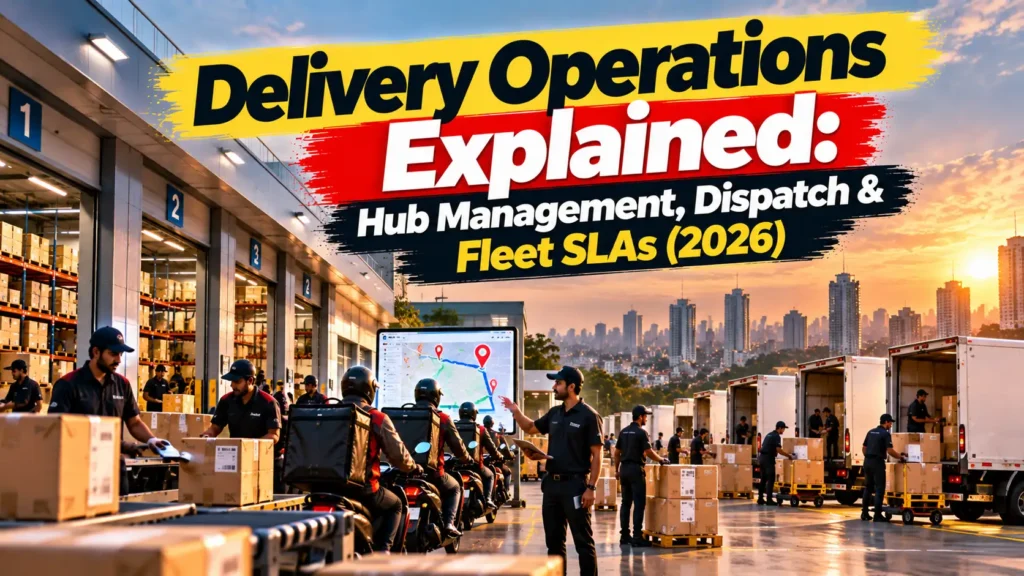
Behind every seamless doorstep delivery—whether it is a hot meal delivered in 30 minutes, an urgent prescription, or a box of groceries delivered in under 10 minutes—lies a sophisticated operational nerve center that never sleeps. While the end consumer interacts solely with a sleek smartphone application, having delivery operations explained reveals the intricate coordination of human capital, warehouse physics, telematics, and real-time fleet orchestration that makes modern fulfillment possible. Delivery operations represent the operational engine room where digital customer orders are transformed into physical logistics execution. If you are eager to build an exciting career within this high-growth operations domain, you can explore verified delivery operations and fleet jobs on AlphaReach to discover immediate-joining supervisory, hub, and rider openings across India today.
In modern supply chains, delivery operations encompass everything that occurs inside the physical distribution hub and on the road: inventory receiving, sorting, capacity planning, rider shift scheduling, dynamic dispatching, real-time exception resolution, and service-level agreement (SLA) tracking. If any single component in this operational chain breaks down, deliveries stall, customer trust evaporates, and operational costs spike.
Furthermore, modern delivery operations in India operate at unprecedented scale and density. A single quick-commerce dark store or e-commerce delivery station often processes between 1,500 and 4,000 orders every single day within tightly defined turnaround windows. In this detailed 2026 operations masterclass, we explore the inner workings of delivery operations, examine core management responsibilities, analyze operational KPI frameworks, and reveal how technology orchestrates peak performance.
The Operations Engine Room: What Delivery Operations Actually Encompasses
To understand delivery operations, one must look beyond individual delivery riders on the road and examine the integrated operational system that directs them. Delivery operations is the discipline of planning, executing, and optimizing the movement of physical goods from a localized fulfillment hub to the customer doorstep, ensuring complete adherence to time, cost, and safety benchmarks.
Operationally, this discipline is divided into two interdependent halves: In-Hub Operations and On-Road Fleet Operations. In-Hub operations focus on warehouse layout, inventory staging, inbound replenishment, parcel sorting, order packing, and outbound dispatch staging. On-Road operations focus on rider shift staffing, dynamic order allocation, turn-by-turn navigation oversight, delivery exception handling, and cash/payment reconciliation.
At a regulatory and infrastructure level, operational safety and vehicle compliance are closely monitored under statutory transport standards administered by the Ministry of Road Transport and Highways (MoRTH). Fleet operators must ensure that all transport assets meet roadworthiness, valid commercial fitness certification, and driver licensing standards to operate seamlessly across municipal and state jurisdictions.
Comparative Blueprint: In-Hub vs. On-Road Operations Responsibilities
Delivery operations leaders must balance warehouse physics with real-time on-road dynamics. While in-hub processes are largely predictable and controlled, on-road operations face unpredictable variables such as urban traffic, weather disruptions, and customer availability.
The analytical table below contrasts the primary operational responsibilities, key performance indicators (KPIs), and daily challenges of in-hub versus on-road delivery operations:
| Operational Domain | Primary Physical Focus | Core Daily Responsibilities | Primary KPIs Tracked | Key Operational Challenges |
| In-Hub (Dark Store / Station) | Fulfillment center floor | Inbound sorting, picking, bagging, bin staging | Pick-to-pack time (<120s), inventory accuracy | Stock discrepancies, physical congestion, bag tears |
| On-Road Fleet Management | Urban streets & customer drops | Rider dispatch, route tracking, rider check-in | First-attempt delivery rate, on-time SLA (>98%) | Traffic bottlenecks, rain delays, GPS drift |
| Fleet Capacity Planning | Shift rosters & demand forecast | Matching rider supply to peak order demand | Rider utilization rate, idle waiting hours | Rider absenteeism during festivals or bad weather |
| Returns & Reverse Logistics | Hub return staging area | Quality checking refused parcels, restocking | RTO processing time, undamaged return rate | Customer disputes, packaging damage during transit |
| Cash & Payment Reconciliation | Hub cash vault & digital ledger | Collecting COD cash, reconciling UPI logs | Zero cash shortage, same-day bank deposit | Discrepancies in cash change, counterfeit notes |
Passionate about operational excellence and want to build a career in delivery operations and fleet management? Discover verified hub supervisor, dispatch, and delivery partner vacancies: explore verified delivery operations and fleet jobs on AlphaReach and apply today.
The Daily Operational Rhythm: From Morning Inbound to Night Reconciliation
A successful delivery hub operates on a disciplined, synchronized 24-hour operational cadence. Understanding this daily rhythm reveals how high-volume fulfillment stations maintain composure under relentless order pressure.
The cycle begins in the early morning hours (4:00 AM to 6:00 AM) with Inbound Freight Receiving. Heavy trucks from regional distribution centers arrive at the local hub to unload consolidated crates and pallets. Inbound associates scan every master barcode, audit physical counts against digital manifests, and distribute goods either directly to dark store picking bins or sorting conveyor tables.
By 6:30 AM to 7:00 AM, Fleet Muster and Dispatch Shift 1 begins. Delivery partners report to the hub, log into partner apps, verify vehicle safety equipment, and receive their morning route manifests. In quick-commerce dark stores, morning breakfast orders surge immediately, requiring instant 10-minute dispatching. Midday operations shift toward lunch delivery and routine inventory replenishment, followed by the massive evening peak rush (6:00 PM to 10:30 PM), where fleet density is maximized. The day concludes with Night Reconciliation: auditing undelivered packages, balancing cash-on-delivery vaults, and running automated replenishment orders for the next morning’s freight.
The Operations Control Tower: Telematics, Algorithms, and Live SLAs
Modern delivery operations are managed through sophisticated digital software interfaces known as Operations Control Towers. A control tower aggregates live data streams from hundreds of connected devices—rider smartphones, vehicle GPS trackers, warehouse barcode scanners, and customer order queues—into a unified visual command center.
Hub managers and dispatch operators monitor live color-coded dashboards. If an order’s packing time exceeds three minutes or a delivery rider experiences an unexpected standstill on an arterial road for more than five minutes, the control tower automatically highlights the anomaly. Operations staff can immediately intervene: re-assigning nearby backup riders, contacting the delivery partner to verify safety, or proactively notifying the customer of adjusted arrival times.
Furthermore, the control tower tracks Service-Level Agreements (SLAs) with pinpoint precision. In quick commerce, the target SLA is typically 98% of orders delivered within 10 to 15 minutes. In e-commerce parcel logistics, the SLA tracks same-day delivery compliance and First-Attempt Delivery Rates (FADR). These metrics directly dictate platform profitability and customer retention.
Overcoming Operational Bottlenecks: Weather, Spikes, and Rider Retention
The true test of a delivery operations team is how effectively it handles unforeseen operational stress events. In logistics, volatility is the only constant: sudden torrential downpours, festival shopping surges, or sudden rider absenteeism can rapidly overwhelm standard capacity.
During peak festival sales (such as Diwali or Great Indian Sales), order volumes can triple overnight. Operations teams manage this through dynamic Fleet Flexing—onboarding temporary part-time delivery partners weeks in advance, establishing satellite staging hubs, and deploying surge pay multipliers to incentivize existing riders to work additional peak shifts.
Weather disruptions represent another severe operational challenge. During monsoon flooding, operations managers adjust delivery radii from 3 kilometers down to 1.5 kilometers to protect rider safety, enable ‘rain surge’ compensation, and temporarily suspend delivery timers on consumer apps to eliminate reckless speeding. By treating frontline rider welfare as a paramount operational priority, world-class operations teams maintain high fleet loyalty and low turnover even during the most demanding seasons.
Join India’s leading delivery operations networks! Earn Rs. 22,000 to Rs. 38,000+ monthly as a delivery partner or hub team lead with flexible shifts, transparent weekly payouts, and free onboarding. apply directly through AlphaReach now.
Frequently Asked Questions (FAQs)
What is the primary role of a delivery operations manager?
A delivery operations manager oversees end-to-end fulfillment at a local hub, managing warehouse sorting, rider shift rosters, dispatch speeds, SLA compliance, cash reconciliation, and customer dispute resolution.
What is a delivery hub or dark store in logistics operations?
A delivery hub or dark store is a hyper-local fulfillment facility located close to residential clusters that holds pre-stocked inventory to fulfill online customer orders rapidly within a 2-3 km radius.
What is an SLA in delivery operations?
A Service-Level Agreement (SLA) is the committed performance standard for delivery—such as delivering within 10 minutes in quick commerce or achieving a 98% on-time delivery rate in e-commerce parcel logistics.
How do delivery operations handle sudden surges during rain or festivals?
Operations teams utilize dynamic surge pricing to attract more delivery partners, shrink delivery radii to keep transit safe, and activate pre-trained part-time backup fleets to absorb volume.
What career growth exists in delivery operations?
Professionals can start as delivery partners or warehouse associates and advance to Hub Team Leads, Station Operations Managers, Area Fleet Coordinators, and Regional Logistics Directors.
Conclusion
Delivery operations represent the vital heartbeat of the modern on-demand economy, translating digital consumer clicks into reliable, rapid, and safe physical reality through structured coordination and disciplined execution.
As supply chains become more decentralized and consumer expectations for instant fulfillment continue to intensify across India, mastering delivery operations—balancing cutting-edge control tower algorithms with compassionate frontline fleet management—remains the ultimate key to sustainable commercial success.