Delivery Boy Monthly Expenses – In 2026, working as a full-time gig delivery partner is a popular livelihood choice for hundreds of thousands of people across India. When browsing job advertisements and payout screenshots, gross earnings of ₹28,000 to ₹38,000 per month look extremely attractive. However, seasoned delivery professionals know that gross income is purely vanity—what actually reaches your family’s bank account is your net income after deducting mandatory operating overheads.
As an independent gig contractor, you are essentially running a micro-business on two wheels. You are responsible for your own operational assets: your two-wheeler’s fuel, routine engine maintenance, tire depreciation, 5G mobile data connectivity, challan risks, and equipment upkeep. Without a clear accounting of delivery boy monthly expenses, riders often find themselves short of cash at the end of the month despite putting in 10-hour daily shifts.
In this detailed 2026 financial analysis, we calculate every single expense incurred by delivery partners across Tier-1 and Tier-2 cities. We will illustrate the stark difference between gross receipts and net profit, helping you optimize your running costs and protect your hard-earned margins.
Categorizing the Operating Expenses of a Gig Delivery Rider
A delivery partner’s monthly expenses can be broadly divided into three main categories: Variable Running Costs, Fixed Operational Overheads, and Asset Wear & Tear.
- Fuel / Petrol (The Largest Cost Center): Averaging 70 to 110 kilometers per day on a standard 110cc–125cc commuter motorcycle consumes approximately 1.5 to 2.4 liters of petrol daily.
- Vehicle Servicing & Consumables: Delivery driving involves continuous stop-and-go city riding, which accelerates engine oil degradation, brake shoe wear, chain slackness, and tire puncture frequency.
- Smartphone & High-Speed Mobile Data: Delivery apps require active GPS location tracking, background order synchronization, and persistent calling, demanding high-data mobile recharge packs.
- Equipment, Safety & Hydration: Rain gear, phone mounts, insulated bag sanitation, charging cables, power banks, and on-road drinking water during extreme weather.
Comprehensive Monthly Expense Breakdown Table (2026)
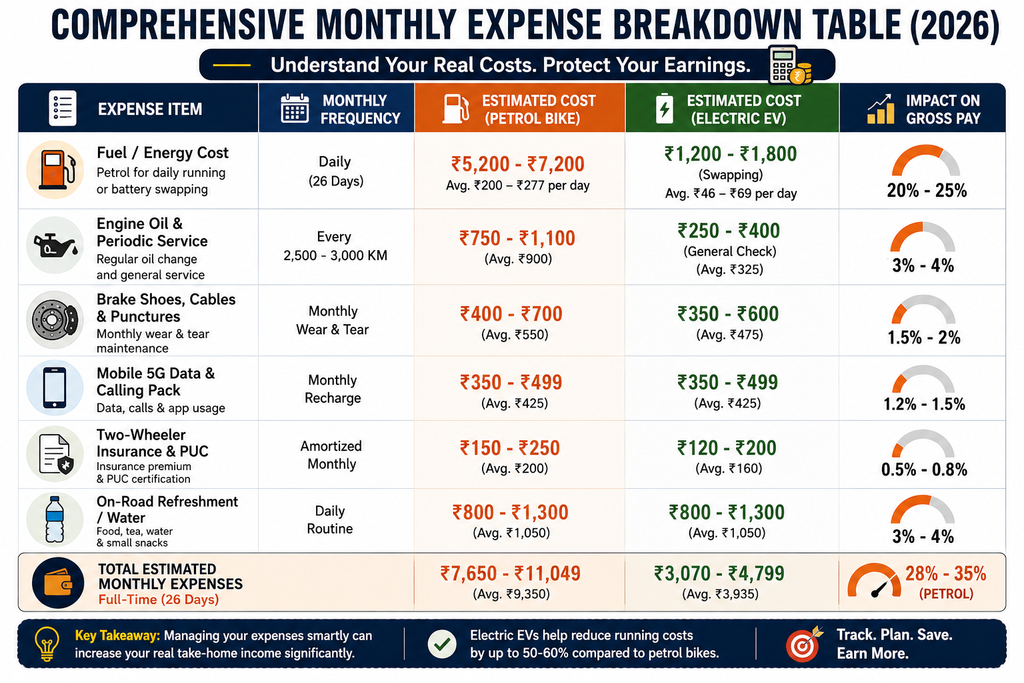
| Expense Item | Monthly Frequency | Estimated Cost (Petrol Bike) | Estimated Cost (Electric EV) | Impact on Gross Pay |
| Fuel / Energy Cost | Daily (26 Days) | ₹5,200 – ₹7,200 | ₹1,200 – ₹1,800 (Swapping) | 20% – 25% |
| Engine Oil & Periodic Service | Every 2,500 – 3,000 KM | ₹750 – ₹1,100 | ₹250 – ₹400 (General Check) | 3% – 4% |
| Brake Shoes, Cables & Punctures | Monthly Wear & Tear | ₹400 – ₹700 | ₹350 – ₹600 | 1.5% – 2% |
| Mobile 5G Data & Calling Pack | Monthly Recharge | ₹350 – ₹499 | ₹350 – ₹499 | 1.2% – 1.5% |
| Two-Wheeler Insurance & PUC | Amortized Monthly | ₹150 – ₹250 | ₹120 – ₹200 | 0.5% – 0.8% |
| On-Road Refreshment / Water | Daily Routine | ₹800 – ₹1,300 | ₹800 – ₹1,300 | 3% – 4% |
| Total Estimated Monthly Expenses | Full-Time (26 Days) | ₹7,650 – ₹11,049 | ₹3,070 – ₹4,799 | 28% – 35% (Petrol) |
> Find high-density delivery routes and hyper-local hubs designed to minimize travel distances and slash your monthly petrol expenses. Browse verified job openings today.
Gross Revenue vs. Net Take-Home Income: Realistic Case Study
To understand the real financial picture, let us examine the numbers of Rider Rajesh, who works 10 hours daily for 26 days a month delivering food and groceries in Pune:
- Gross Platform Earnings (Base + Distance + Incentives): ₹32,400
- Monthly Expense Deductions:
- Petrol (80 KM/day @ ₹104/L, 48 kmpl mileage): -₹4,500
- Engine Oil & Brake Servicing: -₹900
- Mobile Recharge (Unlimited Data): -₹399
- Tire Puncture & Minor Repairs: -₹350
- Daily Water & Tea on Road: -₹950
- Total Expenses Deducted: -₹7,099
- Rajesh’s Real Net Take-Home Income: ₹32,400 – ₹7,099 = ₹25,301
This case study clearly demonstrates that while gross income is ₹32,400, approximately 22% of revenue is absorbed by operating overheads.
Compliance and Road Safety Overhead
In addition to maintenance, adhering to statutory vehicle norms established by the Ministry of Road Transport and Highways (MoRTH) is critical to prevent hefty traffic fines. A single non-functional taillight or expired Pollution Under Control (PUC) certificate can lead to challans ranging from ₹1,000 to ₹10,000, wiping out an entire week’s net profits.
Always ensure your vehicle carries active third-party insurance, a valid fitness/PUC certificate, and that you wear an ISI-certified helmet at all times during your delivery shift.
How to Slash Your Monthly Delivery Expenses by 30%
- Switch to EV Battery Swapping Networks: Transitioning to electric two-wheelers cuts monthly running costs from ₹6,000 to under ₹1,800.
- Bulk Engine Oil & DIY Basic Maintenance: Learn to lubricate your own chain and replace spark plugs at home rather than paying mechanic labor fees.
- Carry Home-Cooked Food and Water Flasks: Buying packaged water bottles and street snacks twice daily costs over ₹1,200 monthly. Carrying an insulated 2-liter flask eliminates this cost completely.
- Optimize Tire Pressure Weekly: Maintaining 28 PSI (Front) and 35 PSI (Rear) extends tire life by 30% and improves fuel efficiency by 2–3 km per liter.
Frequently Asked Questions (FAQs)
What is the biggest monthly expense for a delivery boy in India?
Petrol is by far the largest operational expense, accounting for 65% to 75% of a rider’s total monthly operating costs when using an internal combustion engine motorcycle.
How often should a delivery partner change engine oil?
Due to relentless stop-and-go driving and prolonged idling in traffic, delivery bikes should have their engine oil changed every 2,000 to 2,500 kilometers rather than the standard 4,000 km interval.
Can switching to an electric two-wheeler increase net monthly income?
Yes. An electric vehicle can save between ₹4,000 and ₹6,000 every month in fuel and engine maintenance, directly boosting your net monthly take-home profit.
Does mobile data consumption impact delivery app earnings?
Yes. If your daily high-speed data runs out, the rider app lags, GPS accuracy drops, and you will miss lucrative incoming order broadcasts. Always maintain an unlimited data plan.
> Maximize your net take-home earnings with top-rated delivery platforms offering high milestone incentives. Complete your quick registration and join a winning fleet.
Conclusion
Tracking delivery boy monthly expenses is what separates an amateur gig worker from a successful, profitable delivery entrepreneur. By strictly budgeting your fuel, maintaining your vehicle proactively, and cutting unnecessary on-road leakages, you can preserve your margins and take home maximum earnings every month.