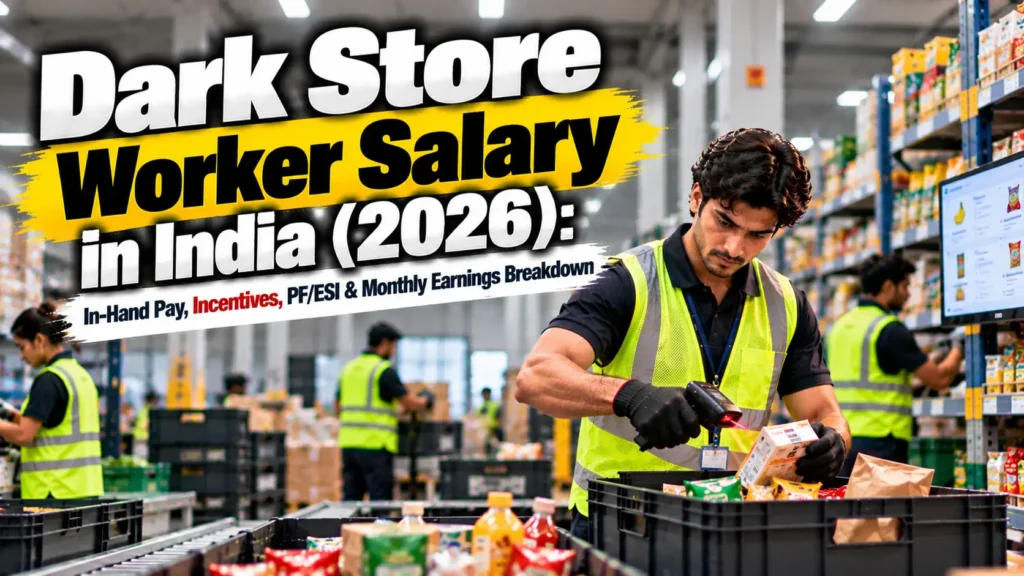
As quick-commerce transforms India’s urban consumer landscape through ultra-fast 10-minute grocery and essentials deliveries, understanding the dark store worker salary structure has become essential for hundreds of thousands of job seekers evaluating frontline employment options. Inside high-velocity micro-fulfillment centers operated by Blinkit, Zepto, Swiggy Instamart, BigBasket Now, and Flipkart Minutes, thousands of pickers, packers, stockers, and inventory handlers maintain the rapid fulfillment rhythm that powers this industry. In 2026, a dark store worker’s monthly earnings combine a reliable base salary, structured attendance bonuses, speed-based picking incentives, and statutory social welfare protections. Monthly gross earnings range from ₹18,000 to ₹26,000, yielding net in-hand monthly pay of ₹16,500 to ₹23,500 across India’s top metropolitan and Tier-2 logistics markets. If you are seeking verified, high-paying dark store vacancies in your city, you can explore verified delivery partner jobs on AlphaReach to locate active openings today.
The compensation model in modern dark stores offers distinct stability compared to commission-based outdoor gig delivery. While delivery riders face variable daily income based on fluctuating order volumes, bad weather, and rising vehicle fuel prices, dark store workers receive guaranteed hourly or monthly basic pay that remains consistent regardless of daily rain or outdoor traffic conditions. Furthermore, dark store workers spend zero money on petrol, bike maintenance, or vehicle insurance, allowing them to retain virtually 100% of their net earnings as take-home savings.
Official employment statistics, urban labor income surveys, and economic welfare datasets published by the Ministry of Statistics and Programme Implementation (MoSPI) highlight the growing formalization of urban retail service wages, demonstrating that technology-enabled logistics hubs offer competitive living standards and upward financial mobility for frontline workers. In this detailed 2026 salary guide, we break down every component of a dark store worker’s paycheck, compare earnings across leading quick-commerce brands, analyze statutory PF/ESI deductions, and reveal practical strategies to maximize your monthly take-home pay.
Detailed Breakdown of Dark Store Worker Salary Components
A typical dark store monthly salary slip consists of five distinct financial components:
- Fixed Basic Pay & Dearness Allowance (DA): The core guaranteed wage reflecting statutory state minimum wage standards for semi-skilled industrial workers, typically ranging from ₹12,000 to ₹15,000 per month.
- Monthly Full Attendance Bonus: Rewarding associates who complete 26 full shifts in a calendar month without unscheduled absenteeism, adding ₹2,000 to ₹3,500 directly to take-home earnings.
- Picking Speed & Order Accuracy Incentives: Performance-based bonuses paid to pickers and packers who maintain average picking speeds under 90 seconds per order while sustaining a 99.5% zero-error rate, yielding an extra ₹1,500 to ₹3,000 monthly.
- Night Shift Allowance: Associates working night shifts (10:00 PM to 6:30 AM) dedicated to bulk receiving and shelf replenishment receive ₹100 to ₹180 per night, generating ₹2,500 to ₹4,500 in additional monthly income.
- Statutory Benefits & Deductions: Mandatory deductions for Employees’ Provident Fund (EPF at 12% of basic) and Employees’ State Insurance (ESIC at 0.75% of gross), matched by mandatory employer contributions that secure long-term savings and free healthcare.
Dark Store Salary Matrix: Designation & Brand Comparison (2026)
Monthly dark store remuneration varies slightly based on role specialization, store sales volume, and operator. The benchmark matrix below outlines realistic 2026 earnings across leading designations:
| Store Designation | Key Daily Task | Base Monthly Salary (₹) | Attendance Bonus (₹) | Performance & Shift Pay (₹) | Net Monthly In-Hand (₹) |
| Order Picker Associate | Speed picking with mobile scanner | ₹15,500 – ₹19,000 | ₹2,000 – ₹3,000 | ₹1,500 – ₹3,000 | ₹16,500 – ₹22,500 |
| Order Packer Associate | Bagging, labeling & dispatch handover | ₹15,000 – ₹18,500 | ₹2,000 – ₹2,800 | ₹1,200 – ₹2,500 | ₹16,000 – ₹21,500 |
| Inbound Stock Replenisher | Night receiving, pallet putaway & binning | ₹16,000 – ₹19,500 | ₹2,000 – ₹3,000 | ₹2,500 – ₹4,000 | ₹18,000 – ₹24,500 |
| Inventory / QC Specialist | Cycle counts, expiry audits & shrinkage logs | ₹17,500 – ₹22,000 | ₹2,000 – ₹3,000 | ₹1,500 – ₹3,000 | ₹18,500 – ₹25,500 |
| Shift Captain / Team Lead | Floor supervision, SLA monitoring & rosters | ₹22,000 – ₹28,000 | ₹2,500 – ₹4,000 | ₹2,000 – ₹4,500 | ₹23,500 – ₹32,500 |
★ High-Paying Warehouse Logistics Opportunity: Are you seeking stable, high-paying warehouse and fulfillment center jobs with competitive monthly salaries, PF/ESI benefits, structured shift rotations, and weekly incentives? explore verified warehouse and logistics jobs on AlphaReach to discover immediate onboarding vacancies across top e-commerce fulfillment hubs, 3PL logistics parks, and dark stores in your city today.
Understanding Monthly Salary Deductions: PF, ESI & Take-Home Math
To calculate your exact net take-home salary from your gross offer letter, understand how statutory social security deductions work:
Gross Salary: Suppose your agreed gross monthly salary is ₹20,000 (comprising ₹13,000 basic pay + ₹4,000 allowances + ₹3,000 attendance bonus).
EPF Deduction (Employee Share): 12% of basic pay (₹13,000 * 12% = ₹1,560) is deducted and deposited into your government EPF account. Your employer contributes an additional matching ₹1,560 toward your provident fund and pension.
ESIC Deduction (Employee Share): 0.75% of gross earnings (₹20,000 * 0.75% = ₹150) is deducted for government health insurance. Your employer pays an additional 3.25% (₹650), giving you and your family free medical care.
Net Take-Home Calculation: ₹20,000 gross – ₹1,560 (EPF) – ₹150 (ESIC) = ₹18,290 directly deposited into your bank account, plus any additional speed incentives earned during the month.
Dark Store Salary vs. Delivery Rider Earnings: A Practical Financial Comparison
Many job seekers debate between working inside a dark store or delivering on a two-wheeler. Comparing real-world finances reveals important distinctions:
Fuel & Vehicle Outlay: Delivery riders spend ₹3,500 to ₹5,000 monthly on petrol and ₹1,000 on bike maintenance. Dark store workers incur zero fuel and zero vehicle costs, often walking or taking public transit.
Weather & Physical Exposure: Delivery riders endure rain, traffic pollution, heatwaves, and accident risks. Dark store employees work inside sheltered, climate-controlled spaces with pure focus on picking and packing.
Income Consistency: Delivery income fluctuates heavily during slow weekdays, while dark store workers enjoy predictable monthly salaries credited on time every month.
Proven Strategies to Maximize Your Monthly Dark Store Pay
High-earning dark store workers utilize practical habits to increase their monthly payout by ₹4,000 to ₹7,000:
- Protect Your Attendance Bonus: Never take unscheduled casual leave; always plan scheduled weekly off-days with your Hub Lead to secure the full ₹2,500 to ₹3,500 attendance bonus.
- Optimize Aisle Navigation: Learn store SKU rack layouts thoroughly during your first two weeks. Knowing exact shelf locations allows you to pick items in under 60 seconds, unlocking top-tier speed bonuses.
- Volunteer for Night Replenishment: Night shifts offer higher daily stipends (₹120 to ₹180 extra per night) and focus on calm bulk stock binning rather than frantic 10-minute customer orders.
- Pursue Lead Captain Promotion: Associates with strong discipline and accuracy are promoted to Shift Lead within 6 to 12 months, raising base pay to ₹25,000+.
★ Fast-Track Your Logistics Career: Ready to unlock top-tier warehouse associate earnings, secure comprehensive healthcare benefits, and advance your logistics career? apply as a verified warehouse associate on AlphaReach to access verified e-commerce openings, automated shift scheduling, and fast 24-hour hiring across leading logistics employers today.
Frequently Asked Questions (FAQs)
What is the starting salary for a dark store worker in India?
Starting net take-home salaries typically range from ₹16,500 to ₹21,500 per month for entry-level pickers and packers, depending on city location, operator, and attendance bonuses.
Do dark store workers get paid weekly or monthly?
Most organized quick-commerce operators (Blinkit, Zepto, Swiggy Instamart) disburse salaries on a fixed monthly cycle (between the 1st and 7th of every month), with some platforms offering weekly incentive payouts.
Are there salary deductions for damaged or returned items?
No. Organized operators have built-in operational shrinkage budgets. Frontline workers are not penalized financially for accidental damage, provided standard operating procedures are followed.
Do dark store employees receive overtime pay?
Yes. When associates work beyond their scheduled 8-hour shift during festive shopping peaks, they receive statutory overtime pay calculated at 1.5x to 2x normal hourly wages.
Is dark store salary higher in metro cities than Tier-2 towns?
Metro cities (Delhi-NCR, Mumbai, Bengaluru) offer ₹1,500 to ₹3,000 higher basic pay due to higher statutory minimum wages and living costs compared to Tier-2 locations like Jaipur or Lucknow.
Conclusion
A dark store worker salary provides one of the most reliable, cost-effective, and dignified income foundations in India’s modern retail supply chain. With zero vehicle expenses, guaranteed base pay, valuable health insurance, and structured speed incentives, dark store workers enjoy stable net savings and predictable financial progress.
By prioritizing attendance, mastering store layouts, and maintaining high picking accuracy, motivated workers can consistently maximize their monthly earnings while building pathways to supervisory management. Explore verified dark store job openings today and secure your financial future.