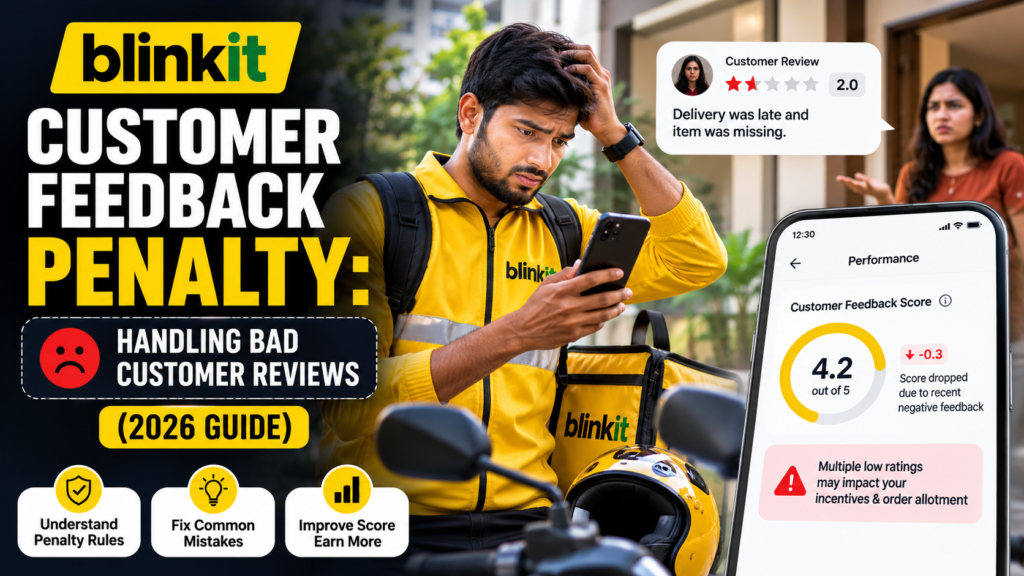
The quick-commerce landscape in India has completely revolutionized the way consumers purchase daily essentials. By offering rapid, hyper-local deliveries, Blinkit has established itself as an absolute powerhouse in the gig economy ecosystem. For the hundreds of thousands of delivery partners navigating chaotic city streets—as well as the dedicated picker and packer staff operating inside the micro-warehouses—the platform provides a scalable, flexible, and lucrative source of weekly income. However, behind the seamless customer experience lies a sophisticated and highly unforgiving operational algorithm.
In 2026, the entire quick-commerce model operates on absolute precision, speed, and customer satisfaction. While delivering an order safely is your primary physical task, your financial success on the platform is heavily dictated by a hidden digital metric: your customer feedback score. When a customer receives their groceries, they are prompted to rate their experience. A 5-star rating acts as a shield for your profile, keeping your earnings intact. But what happens when things go wrong?
A single frustrated customer can trigger a severe Blinkit customer feedback penalty, leading to systemic account restrictions, lost incentives, and a massive drop in daily payouts. Furthermore, the platform has recently expanded these metrics to evaluate the internal staff, implementing strict Rating requirements for Dark Stores.
If you are a delivery partner or a dark store operator struggling with sudden ID pauses, diminished order allocations, or unfairly lost incentives, this comprehensive guide is for you. We will break down exactly how the Blinkit algorithm calculates your rating, explore the financial consequences of bad reviews, outline the strict operational rules inside dark stores, and provide actionable, veteran strategies for handling bad customer reviews to ensure your earnings are never compromised.
> Facing challenges with customer feedback? Explore current Blinkit delivery jobs and other rider opportunities to find a role that suits your schedule.
Understanding the Blinkit Customer Feedback Penalty
To successfully operate within the Blinkit network, you must first understand how the platform mathematically tracks your performance. Blinkit does not evaluate its partners purely on how fast they ride their motorcycles. The algorithm utilizes a blended performance score that balances delivery speed with ultimate customer satisfaction.
The Blinkit customer feedback penalty is an automated system designed to weed out poor service, repeated delays, and unprofessional behavior. When a customer leaves a rating (typically on a 1-to-5 star scale) or submits a specific complaint (such as “Spilled Food,” “Rude Rider,” or “Missing Items”), that data is instantly fed into your rolling average score.
How the Penalty System is Triggered
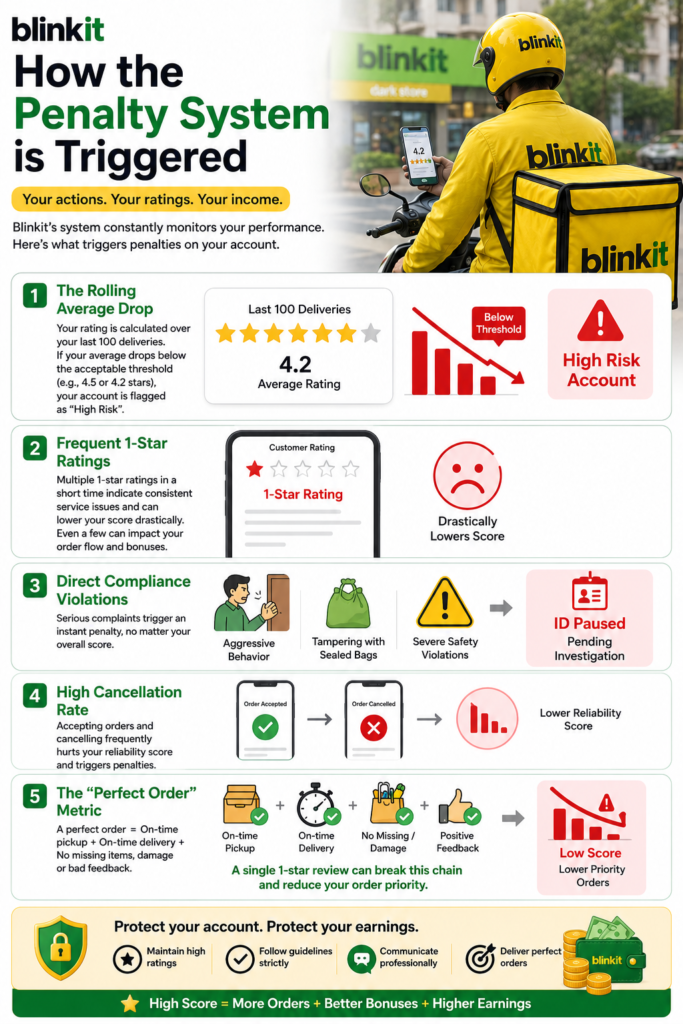
- The Rolling Average Drop: Your rating is usually calculated over your last 100 deliveries. If your average score drops below a predetermined acceptable threshold (e.g., dropping below 4.5 or 4.2 stars), the system automatically flags your account as “High Risk.”
- Direct Compliance Violations: Certain customer complaints trigger an immediate Blinkit customer feedback penalty regardless of your overall average. For example, if a customer explicitly reports aggressive doorstep behavior, tampering with sealed grocery bags, or severe safety violations, the system can instantly pause your ID pending an investigation.
- The “Perfect Order” Metric: Blinkit expects a near-perfect fulfillment rate. A perfect order is defined as a delivery picked up on time, delivered within the estimated time of arrival (ETA), and handed over without any missing items, physical damage, or negative feedback. When a 1-star review shatters this metric, the algorithm immediately penalizes your order allocation priority.
Rating Requirements for Dark Stores: The Internal Ecosystem
One of the most significant shifts in the 2026 quick-commerce model is the realization that delivery partners are not the only ones responsible for the customer experience. A massive portion of customer complaints—such as missing items, crushed bread, or expired products—are actually the fault of the internal dark store operations.
To create a fairer system, Blinkit has implemented stringent Rating requirements for Dark Stores, extending the evaluation metrics to the pickers, packers, and store managers operating inside the micro-warehouses.
How Pickers and Packers are Evaluated
Inside a Blinkit dark store, when an order pings, the internal staff has roughly 60 to 90 seconds to locate the items, scan the barcodes, bag the groceries, and hand them to the waiting delivery partner.
- Accuracy and Speed Metrics: Pickers are rated on their real-time performance. They must accurately read labels and locate items efficiently without relying entirely on manual guidance.
- Customer Feedback Linking: If a customer leaves a 1-star review citing “Missing Item” or “Wrong Item Delivered,” the algorithm now traces that specific order back to the exact picker and packer who sealed the bag at the dark store.
- The Penalty: If a dark store worker consistently fails to meet the Rating requirements for Dark Stores, accumulating too many accuracy penalties, they face severe consequences, ranging from retraining sessions by the store manager to outright removal from the dark store network.
By implementing these internal Rating requirements for Dark Stores, Blinkit ensures that delivery partners are not unfairly bearing the brunt of the Blinkit customer feedback penalty for mistakes made during the bagging process.
The Financial Impact: How Bad Reviews Damage Your Payouts
Many new gig workers mistakenly assume that as long as they physically drop off the parcel, they will receive their full payout. However, a Blinkit customer feedback penalty is not a direct fine—Blinkit does not simply deduct ₹50 from your wallet for a bad rating. Instead, a low rating reduces your ability to earn future money through systemic algorithmic restrictions.
Here is exactly how a poor customer rating financially cripples your daily shifts:
1. Order Allocation Downgrade (The Priority Penalty)
Blinkit’s dispatch algorithm actively favors high-rated riders. If you maintain a pristine 5-star rating, the system will ping your phone first when a lucrative, short-distance order becomes available near the dark store. If a string of bad reviews triggers a Blinkit customer feedback penalty, you are instantly demoted to the bottom of the priority queue. You will suffer from brutal “idle time,” sitting outside the dark store for 30 to 45 minutes waiting for an order, while top-rated riders get back-to-back deliveries. Fewer orders directly equal less base pay.
2. Lockout from Milestone Incentives
The real profit in quick-commerce delivery does not come from the standard ₹20 to ₹30 base pay per order; it comes from Daily Milestone Incentives. Blinkit pays massive cash bonuses for hitting daily targets (e.g., an extra ₹200 for completing 15 orders, or ₹400 for completing 25 orders). Because a bad rating lowers your order allocation priority, it becomes mathematically impossible to hit 25 orders in a single shift. You lose out on the milestone bonus entirely, effectively slashing your daily net profit in half.
3. Exclusion from Premium Surge Pricing
During high-demand windows (like a Saturday morning grocery rush, festival days, or a sudden monsoon downpour), Blinkit applies “Surge Pricing,” offering an extra ₹15 to ₹40 per delivery. High-rated riders are automatically routed into these surge zones. Riders suffering from a Blinkit customer feedback penalty are frequently excluded from premium surge orders, leaving them to fulfill low-paying, standard deliveries on the outskirts of the active zones.
Mastering the Doorstep: Handling Bad Customer Reviews
One of the most frustrating realities of the gig economy is that delivery partners are often penalized for variables completely outside of their control. A customer’s 1-star rating is frequently a reaction to the overall experience (such as the app crashing, an item being out of stock, or heavy traffic) rather than the rider’s actual performance.
To protect your earnings, you must actively manage your customer interactions and mitigate anger before it turns into a bad review. Here are highly effective, veteran strategies for handling bad customer reviews and maintaining a flawless rating:
1. Proactive Communication During Delays
Do not wait for the customer to get angry. If you reach the dark store and realize the internal staff is backed up, or if you are stuck at a police barricade or in heavy traffic, immediately use the Blinkit app’s chat feature or call the customer.
- Action: Send a polite message: “Hello Sir/Ma’am! I have picked up your order from the Blinkit store, but I am stuck in severe traffic due to roadwork. I will safely reach your location in an extra 5 minutes. Thank you for your patience!”
- Customers deeply appreciate transparency. By setting the right expectation and communicating proactively, you prevent them from opening the app in frustration and leaving a bad rating for a delay.
2. The “Fragile Handling” Technique
The absolute number one cause of a Blinkit customer feedback penalty is damaged or spilled groceries. Customers frequently order fragile items like eggs, glass jars, soft bread, and milk pouches. If you carelessly toss the sealed bag into your thermal backpack and crush the bread, the customer will instantly leave a 1-star review.
- Action: Always place heavy items (like 5-liter water bottles or heavy flour sacks) at the bottom of your bag, and delicate items at the very top. A pristine, undamaged grocery bag guarantees a satisfied customer.
3. Never Argue Over Missing Items
Because of the strict Rating requirements for Dark Stores, pickers pack items incredibly fast, and occasionally, an item is missed. Because you receive a sealed bag, you are strictly forbidden from opening it to verify the contents. If a customer opens the bag at the door and yells that a packet of butter is missing, do not argue with them.
- Action: Remain perfectly calm, apologize for the oversight, and instruct them on how to get an instant refund. Say: “I sincerely apologize for the inconvenience. The store hands us completely sealed bags for hygiene reasons. Please click on ‘Help’ in your Blinkit app and report the missing item. The customer support team will process an instant refund for you right now.” Diffusing their anger directs their frustration at the platform rather than your personal rider rating.
4. The Polite Rating Request
Many customers simply forget to rate their riders if the delivery goes smoothly. People usually only open the rating screen when they are angry. You must actively ask satisfied customers to rate you to dilute the impact of rare bad reviews.
- Action: At the doorstep, always smile, greet the customer, and hand the bag over carefully by the handles. As you leave, politely say: “Sir/Ma’am, if you are happy with the quick delivery, please give a 5-star rating on the app. It really helps me achieve my daily targets.” A polite request significantly boosts the volume of positive ratings.
How to Dispute an Unfair Blinkit Customer Feedback Penalty
Even if you follow all the rules, you may eventually receive a blatantly unfair 1-star review from an unreasonable customer. Blinkit understands that the system is not perfect. If you believe your rating was damaged unfairly, you have the right to dispute the penalty through the official partner support channels.
- Log Delays in Real-Time: The best defense against an unfair rating is a proactive digital paper trail. If the dark store is taking too long to hand over the bag, use your Partner App to log an “Order Delayed at Store” ticket while you are waiting. If a customer rates you poorly for this specific delay, the Blinkit algorithm will automatically check the timestamps, see that the delay was the store’s fault, and exempt that trip from negatively impacting your rating.
- Report Abusive Customers: If a customer is verbally abusive, demands that you enter their private home (which violates safety protocols), or forces you to wait an unreasonable amount of time at the gate, report the customer via the SOS or Support button immediately after completing the trip. Documenting the bad behavior ensures that their retaliatory 1-star review is nullified by the backend support team.
- Regularly Check Your Performance Dashboard: Make it a habit to check your metrics dashboard every morning before starting your shift. If you notice a sudden drop in your rating due to a Blinkit customer feedback penalty, reach out to your fleet manager or raise a support ticket asking for clarity. Often, backend teams can audit the feedback and remove unfair ratings if they violate the platform’s review policies.
> Ready for your next delivery opportunity? Apply as a delivery partner and discover flexible gig work while building better customer experiences.
Frequently Asked Questions (FAQs)
Q1: Will my Blinkit delivery ID be permanently blocked if I receive a single 1-star rating?
No. A single 1-star rating will not lead to a permanent block or termination. Because the rating is calculated on a rolling average, a single bad review will only temporarily lower your overall score, which might reduce your order allocation priority for a few days. You can easily recover by completing the next 20 to 30 orders flawlessly and asking for 5-star ratings.
Q2: How do the Rating requirements for Dark Stores affect me as a delivery partner?
The strict Rating requirements for Dark Stores are highly beneficial to delivery partners. Because the internal pickers and packers are now held accountable for missing or wrong items via their own rating system, the algorithm is much better at identifying when a customer complaint is the dark store’s fault rather than the rider’s fault. This protects your personal rating from being penalized for packing errors.
Q3: Can I ask the customer to change a bad rating after they have submitted it?
No. Once a customer submits a rating on the Blinkit app, it is locked into the system. You should never return to a customer’s home or call their personal number to argue about a bad rating, as this is a severe violation of privacy and safety policies and will result in immediate termination. Handle all disputes through the in-app support ticketing system.
Q4: Does my customer feedback score affect my Cash-on-Delivery (COD) limits?
Indirectly, yes. Highly rated veteran riders who maintain excellent customer feedback and a high “Perfect Order” metric are often rewarded by the algorithm with higher trust scores. This higher trust score grants them a larger floating cash limit, meaning their ID gets paused less frequently during busy shifts when handling COD orders.
Q5: What should I do if a customer gives a bad rating because the app crashed or the GPS was wrong?
If the delay was caused by a technical glitch, a faulty GPS pin dropped by the customer, or an app outage, immediately raise a ticket through the Partner App support section under “Navigation Issues.” Documenting the technical failure ensures that the backend team can override the unfair Blinkit customer feedback penalty and protect your metrics.