The digital economy in India has been growing at an unprecedented rate. From piping hot meals arriving at our doorsteps in minutes to instant cab rides and quick-commerce grocery deliveries, the convenience of the modern world rests heavily on the shoulders of millions of gig and platform workers. However, this convenience has historically come at a steep human cost. Navigating treacherous traffic, extreme weather conditions, and high-pressure delivery timelines, gig workers face immense occupational hazards daily.
In what is being hailed as a watershed moment for labor rights in India, the Telangana government has announced a first-of-its-kind financial assistance program for gig and platform workers. Acknowledging the indispensable contribution of these unsung heroes to the rapidly expanding digital economy, the state has mandated a robust compensation structure for the families of gig workers who tragically lose their lives in road accidents while on duty.
This landmark decision not only provides immediate financial relief but also sets a profound national benchmark for how the digital workforce should be treated in the 21st century.
The Compensation Breakdown: A Dual-Responsibility Model
What makes the Telangana initiative truly groundbreaking is its “Dual-Responsibility” approach. It does not solely rely on the state exchequer, nor does it entirely shift the burden to corporate entities. Instead, it creates a collaborative safety net.
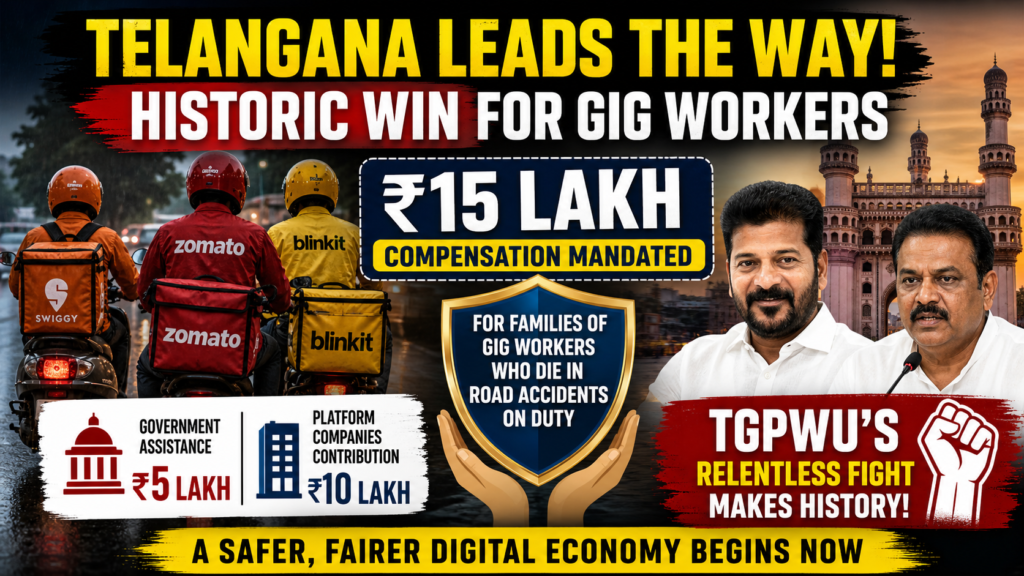
As per reports by Times of India Under the new mandate, the financial assistance totals ₹15 lakh per family, structured as follows:
- State Government Assistance: The Telangana government will directly provide ₹5 lakh to the kin of the deceased gig worker.
- Platform Company Contribution: In addition to the state’s support, the respective e-commerce or delivery platform company (such as Swiggy, Uber, Zomato, or Blinkit) is mandated to provide ₹10 lakh as compensation.
This cooperative model ensures substantial and meaningful financial support for grieving families, preventing them from falling into immediate destitution following the loss of a primary breadwinner.
The Champions Behind the Change: TGPWU’s Relentless Pursuit
Major policy shifts rarely happen overnight, and this initiative is no exception. It is the culmination of years of relentless advocacy, protests, and negotiations led by gig worker unions.
Shaik Salauddin, the Founder President of the Telangana Gig and Platform Workers Union (TGPWU), has been at the forefront of this battle. For years, Salauddin has been amplifying the voices of delivery partners and transport workers, highlighting the severe lack of social security, medical insurance, and accidental coverage in a sector characterized by algorithmic pressure and “independent contractor” loopholes.

Earlier this year, Salauddin raised the pressing issue of gig worker social security directly with Chief Minister A. Revanth Reddy. The ensuing dialogue bridged the gap between grassroots realities and legislative action. Speaking on the historic announcement, Labour Minister G. Vivek Venkataswamy publicly appreciated the TGPWU’s persistent follow-up with the Chief Minister’s Office (CMO) and the labor department. He acknowledged that the union’s active involvement played a pivotal role in making this visionary initiative a reality.
Describing the move as a “historic victory,” Salauddin emphasized that this is just the beginning. “The union will continue to push for comprehensive social security, including accident insurance, welfare benefits, and legal protections for gig workers,” he stated, signaling that the fight for equitable working conditions remains an ongoing mission.
Why the Gig Economy Desperately Needed This Intervention
To understand the magnitude of this policy, one must look at the grim reality of the gig workforce in India. Currently, millions of young Indians are employed by major aggregators. However, because they are legally classified as “partners” or “independent contractors” rather than official “employees,” they are effectively excluded from traditional labor laws.
This classification strips them of standard employee benefits like the Employee State Insurance (ESI), Provident Fund (PF), paid leaves, and life insurance.
- The Pressure of the Algorithm: Delivery platforms often gamify their apps, offering incentives for completing a certain number of deliveries within strict timeframes. This pushes riders to speed, break traffic rules, and take unnecessary risks, leading to a high rate of fatal road accidents.
- The Financial Void: Prior to this mandate, if a rider met with a fatal accident, their family was left at the mercy of discretionary, often meager, corporate payouts, or complicated third-party insurance claims that took years to clear.
The Telangana mandate cuts through this red tape, establishing a clear, undeniable financial obligation that respects the value of a gig worker’s life.
The Ripple Effect: Will Other States Follow Suit?
Telangana is not operating in a vacuum. The conversation around gig worker rights has been gaining momentum across India. Rajasthan previously made headlines by passing the Rajasthan Platform Based Gig Workers (Registration and Welfare) Act, aiming to create a welfare board and a dedicated fund. Karnataka has also been drafting similar bills to ensure social security.
However, Telangana’s approach of enforcing a direct, immediate, and high-value compensation payout (₹15 Lakh) specifically for fatalities sets a highly tangible and immediate standard. This move will undoubtedly put immense pressure on other state governments and the central government to implement nationwide frameworks.
Furthermore, it forces major tech aggregators—who frequently boast about their massive valuations and exponential growth—to factor human welfare directly into their operational costs. It is a clear message that innovation and profitability cannot come at the expense of basic human dignity and safety.
Conclusion: A Step Toward a Sustainable Digital Economy
The digital economy is here to stay. It has democratized access to services, created flexible earning opportunities, and transformed consumer habits. However, true economic progress must be inclusive. A system that thrives on the labor of millions while offering them no safety net is inherently unsustainable.
The Telangana government’s decision to mandate a ₹15 lakh compensation for deceased gig workers is more than just a financial policy; it is a profound moral statement. It acknowledges that the delivery boy bringing your groceries in the pouring rain, or the cab driver navigating midnight traffic, is an integral, valuable part of the state’s economic machinery.
While there is still a long road ahead to secure comprehensive rights—including fair wages, protection against arbitrary ID blocks, and full medical coverage—this historic victory in Telangana shines a bright light at the end of the tunnel. It proves that when the government, corporate platforms, and relentless worker unions come together, the digital economy can become a safer, fairer place for everyone.