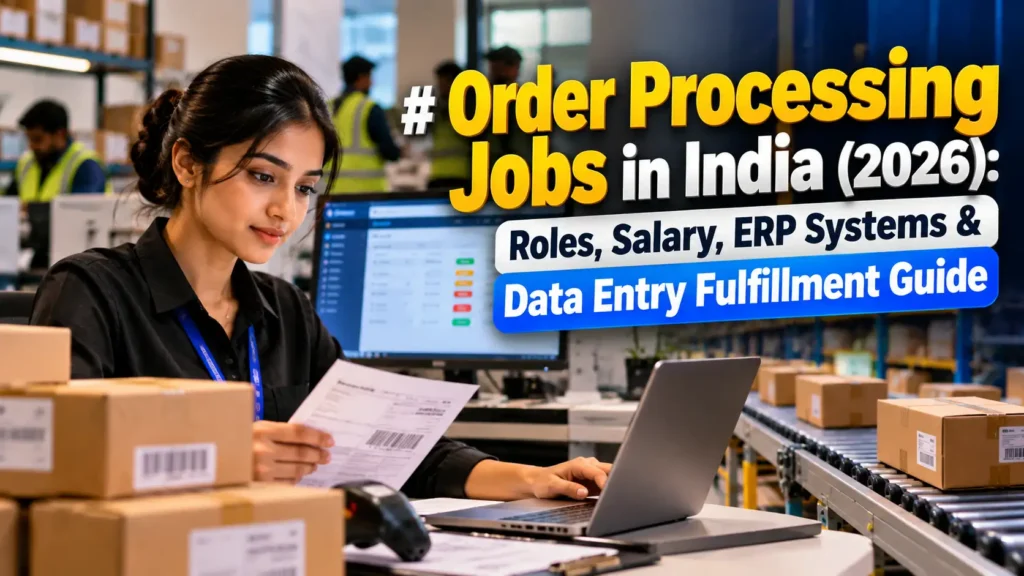
In modern India’s rapidly digitalizing corporate supply chain, e-commerce, and wholesale distribution sectors, order processing jobs represent a critical administrative and operational bridge converting online customer orders into actionable warehouse fulfillment tasks. Operating within corporate fulfillment offices, logistics hubs, retail distribution depots, and e-commerce marketplace centers for Amazon, Flipkart, Reliance Retail, Tata 1mg, and major FMCG enterprises, an order processing executive manages the end-to-end digital lifecycle of an order. From validating customer payments and verifying inventory availability to generating tax invoices, issuing warehouse pick lists, and tracking fulfillment statuses on enterprise ERP platforms like SAP, Oracle NetSuite, and Microsoft Dynamics, order processing professionals ensure that customer demand is accurately transmitted to physical fulfillment floors with zero delay. In 2026, the nationwide explosion of omnichannel retail and enterprise B2B commerce has created immense corporate demand for skilled order processing executives, offering gross monthly salaries ranging from ₹20,000 to ₹34,000, supported by statutory PF, ESI, performance bonuses, comfortable desk-based work environments, and direct promotional tracks into supply chain and operations management. If you are seeking verified order management and logistics opportunities across certified regional employers, you can explore verified delivery partner and warehouse jobs on AlphaReach to locate hiring centers in your metropolitan area today.
The operational excellence of an order processing executive lies in computer software fluency, commercial accuracy, and swift exception handling. When a customer places an order online, the order processing system must verify payment confirmation, check stock availability across regional fulfillment centers, generate GST-compliant invoices, and assign optimal warehouse routing to minimize shipping transit times. When customer orders experience payment drops, out-of-stock items, or incorrect delivery addresses, the order processing executive investigates discrepancies, coordinates with customer service teams, and modifies ERP records, ensuring seamless fulfillment execution.
Under national digital commercial governance and electronic invoicing standards administered by the Ministry of Electronics and Information Technology (MeitY), order processing operations adhere to strict digital security, GST e-invoicing compliances, and customer data privacy standards. In this comprehensive 2026 career handbook, we dissect the core responsibilities of an order processing executive, benchmark industry compensation scales, review essential software and spreadsheet capabilities, and map out a direct promotional pathway to senior operations and supply chain management.
The 5 Core Responsibilities of an Order Processing Executive
An order processing executive governs the digital order fulfillment pipeline across five crucial areas:
- Digital Order Ingestion & Payment Validation: Monitoring incoming electronic orders from marketplace portals (Amazon, Flipkart, Shopify, proprietary webstores), verifying payment gateways, and approving orders for fulfillment.
- Inventory Allocation & Warehouse Pick List Generation: Checking real-time stock levels across regional fulfillment centers on ERP systems, reserving inventory, and releasing digital pick lists to warehouse picking teams.
- GST Tax Invoicing & e-Invoice Generation: Creating statutory commercial invoices, generating GST e-invoices with valid Quick Response (QR) codes, and printing accompanying shipping manifests.
- Order Modification, Cancellation & Exception Management: Handling order cancellations, address corrections, customer phone number updates, and coordinating with inventory teams when stock mismatches occur.
- Fulfillment Status Tracking & SLA Reporting: Tracking order progression from ‘Processing’ to ‘Picked,’ ‘Packed,’ and ‘Dispatched,’ compiling daily order volume reports, and monitoring on-time fulfillment SLAs.
Order Processing Salary Scale & Compensation Matrix (2026)
Compensation reflects software expertise, company scale, and transaction volume. The benchmark matrix below details typical monthly earnings for order processing executives in India:
| Industry Segment / Employer Type | Typical Experience Level | Gross Monthly Salary (₹) | Statutory Deductions (PF/ESI) (₹) | Monthly Performance Bonus (₹) | Net Monthly Take-Home (₹) |
| E-Commerce Marketplace (Amazon/Flipkart) | 1 – 3 Years | ₹22,000 – ₹34,000 | ₹2,200 – ₹3,400 | ₹2,500 – ₹5,000 | ₹22,300 – ₹33,600 |
| FMCG / Consumer Goods Corporate Office | 1 – 3 Years | ₹21,000 – ₹30,000 | ₹2,100 – ₹3,000 | ₹2,000 – ₹4,000 | ₹20,900 – ₹29,000 |
| B2B Wholesale & Industrial Distribution | 2 – 4 Years | ₹24,000 – ₹35,000 | ₹2,400 – ₹3,500 | ₹2,500 – ₹5,000 | ₹23,100 – ₹34,500 |
| Pharmaceutical & Healthcare Supply Hub | 1 – 3 Years | ₹23,000 – ₹32,000 | ₹2,300 – ₹3,200 | ₹2,000 – ₹4,500 | ₹22,200 – ₹31,300 |
| Quick-Commerce Regional Control Center | 0 – 2 Years | ₹20,000 – ₹28,000 | ₹2,000 – ₹2,800 | ₹1,500 – ₹3,500 | ₹19,500 – ₹26,700 |
★ Verified Delivery Hub & Logistics Opportunities: Looking for verified logistics, delivery station, or warehouse career opportunities? Explore open delivery operations and hub associate vacancies on AlphaReach to connect directly with top-rated supply chain employers in your city today.
Essential Qualifications, Software Skills & Technical Competencies
Succeeding as an order processing executive requires a mix of academic credentials and computer software fluency:
- Educational Credentials: A bachelor’s degree in commerce (B.Com), business administration (BBA), science (B.Sc), or arts (BA). Candidates with commerce or accounting backgrounds are preferred for invoicing roles.
- Enterprise ERP & Order Management Software: Hands-on familiarity with ERP software such as SAP Business One, Oracle NetSuite, Microsoft Dynamics 365, Tally Prime, or proprietary e-commerce OMS platforms (Vinculum, Unicommerce).
- Spreadsheet & Data Entry Speed: Fast and accurate typing speed (30+ words per minute) alongside strong Microsoft Excel proficiency (VLOOKUP, basic pivot tables, conditional formatting, text-to-columns).
- Attention to Detail & Numeric Accuracy: Ability to spot price discrepancies, tax rate mismatches, and address errors before invoices are finalized.
- Written & Verbal Communication: Clear professional communication in English and Hindi to coordinate with warehouse leads, account managers, and customer support representatives.
A Day in the Life: Operational Workflow of an Order Processing Executive
An order processing executive’s day follows a disciplined, computerized sequence:
- 09:00 AM – Morning Order Queue Audit: Log into the ERP order dashboard, review overnight customer orders, filter high-priority express shipments, and verify payment settlements.
- 10:30 AM – Pick List Release & Warehouse Coordination: Allocate inventory across regional fulfillment nodes, release automated pick tickets to the warehouse floor, and monitor picking progress.
- 01:00 PM – Invoice & e-Way Bill Batch Generation: Generate statutory tax invoices, validate GST e-invoices through government portals, and transmit digital packing slips to packaging benches.
- 03:30 PM – Exception Handling & Cancellation Processing: Investigate address discrepancies, process customer cancellation requests, and adjust warehouse inventory records.
- 05:30 PM – Daily Reconciliation & SLA Reporting: Compile daily order metrics (total orders received, processed, pending, canceled) and share status reports with operations management.
Top 5 Career Milestones: Advancing to Supply Chain Operations Leadership
An ambitious order processing executive can progress through five structured corporate milestones:
- Order Processing Executive (Years 1 – 2): Master OMS/ERP software, achieve 99.8%+ order processing accuracy, and maintain fast invoice turnaround times.
- Senior Order Management Specialist (Years 2 – 3): Manage multi-channel marketplace integrations (Amazon, Flipkart, Shopify), train junior executives, and handle enterprise B2B accounts.
- Order Fulfillment Team Lead (Years 3 – 5): Supervise an entire order management department, oversee fulfillment SLA compliance, and coordinate cross-functional logistics workflows.
- Assistant Supply Chain Operations Manager (Years 5 – 7): Direct overall inventory planning, manage software vendor contracts, and optimize nationwide order routing algorithms.
- Supply Chain Operations Director (Years 7+): Corporate executive role leading enterprise supply chain digital transformation, warehouse automation, and multi-crore logistics strategies.
★ Fast-Track Your Delivery Hub Career Today: Ready to start earning with top-paying e-commerce hubs, express logistics networks, or quick-commerce delivery centers? Register through AlphaReach to access fast-track onboarding, transparent pay, and verified shift placements today!
Frequently Asked Questions (FAQs)
What is an order processing job?
An order processing job involves managing the administrative and digital fulfillment of customer orders. Key tasks include receiving online orders on ERP systems, verifying customer payments, checking inventory availability, generating GST tax invoices and packing slips, releasing pick lists to warehouse teams, handling order cancellations, and tracking fulfillment progress.
What is the average starting salary for an order processing executive in India?
In 2026, the gross monthly salary for an entry-level order processing executive in India typically ranges from ₹20,000 to ₹30,000 per month. With quarterly performance bonuses, net monthly take-home earnings generally range between ₹19,500 and ₹28,000.
What qualifications are needed to become an order processing executive?
Most corporate employers seek candidates who have completed a bachelor’s degree in any discipline (B.Com, BBA, B.Sc, BA). Candidates should possess good typing speed, strong proficiency in Microsoft Excel, and familiarity with ERP or billing software like SAP, Tally, or Unicommerce.
Is an order processing job a desk job or a warehouse floor job?
An order processing job is primarily a desk-based computer role. Executives work in air-conditioned fulfillment offices or corporate logistics control rooms using desktop computers and enterprise software, maintaining close coordination with warehouse floor operations via messaging and internal systems.
What career advancement opportunities exist for an order processing executive?
An order processing executive can advance through corporate supply chain milestones, progressing to Senior Order Management Specialist, Fulfillment Team Lead, Assistant Supply Chain Operations Manager, and ultimately Supply Chain Director.
Conclusion
Order processing jobs in 2026 represent a vital, stable, and highly rewarding administrative career in India’s booming digital commerce and supply chain infrastructure. Operating at the digital command center of modern commerce, order processing executives bridge customer demand with physical warehouse execution, ensuring that millions of transactions translate into accurate, timely doorstep deliveries.
By mastering enterprise ERP systems, sharpening spreadsheet and data analysis capabilities, maintaining immaculate invoice accuracy, and resolving fulfillment exceptions with speed, an ambitious professional can quickly climb the ladder to senior supply chain leadership. Enter the order management arena today to build a prosperous, future-proof career in modern corporate logistics.