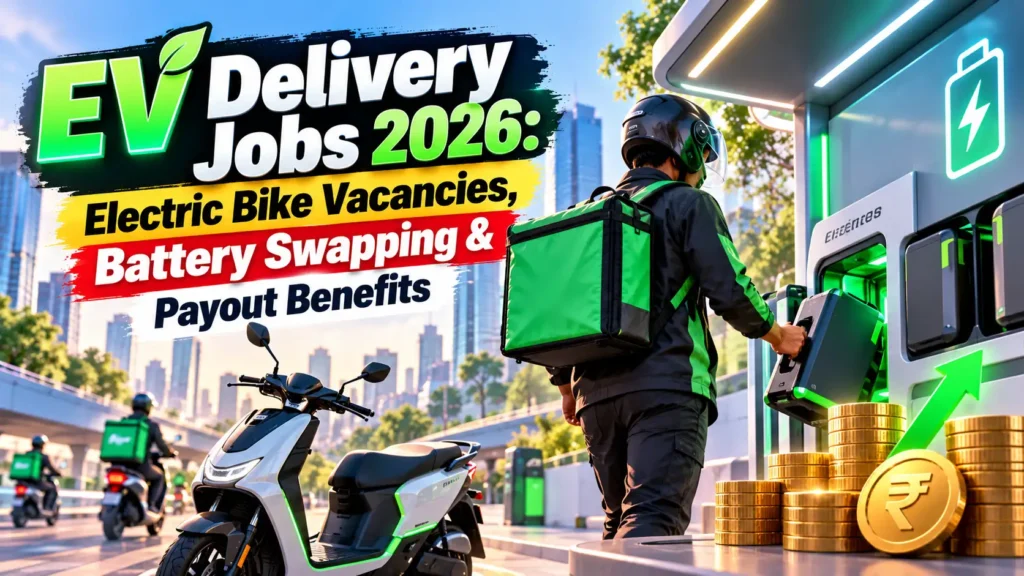
The Indian on-demand logistics and quick commerce industry is undergoing a historic green mobility revolution. Driven by ambitious sustainability mandates, escalating petrol prices, and state government zero-emission commercial transport policies, major gig platforms—including Blinkit, Zomato, Swiggy, Zepto, BigBasket, and Amazon—are aggressively shifting their two-wheeler fleets toward electric mobility. As a result, EV delivery jobs have emerged as the fastest-growing and most financially rewarding employment segment in the urban gig economy.
Operating an electric two-wheeler completely eliminates the crushing daily petrol expense of ₹250 to ₹350 that erodes conventional courier earnings. With innovative battery-swapping networks allowing riders to exchange depleted battery packs for fully charged units in under two minutes, range anxiety has been permanently solved for hyper-local delivery couriers. Riders eager to secure high-paying electric fleet positions can explore verified openings on delivery partner jobs. In this complete career guide, we detail how EV delivery vacancies operate, compare battery swapping versus home charging, outline affordable daily rental models (even for candidates who do not own a vehicle), and highlight how going green boosts your monthly take-home profit by up to 25%.
Why Platforms Are Prioritizing EV Delivery Partners in 2026
The rapid expansion of EV delivery jobs across Indian metros is fueled by both commercial economics and regulatory policy. Quick commerce platforms operate on razor-thin unit economics where delivery cost per kilometer is a decisive metric. Electric two-wheelers slash operating costs from ₹2.50–₹3.00 per kilometer on petrol down to ₹0.40–₹0.80 per kilometer on electricity, unlocking massive logistical efficiencies.
Furthermore, state-level environmental regulations, such as Delhi’s Motor Vehicle Aggregator and Delivery Service Provider Scheme, mandate that commercial delivery fleets transition 100% of their two-wheelers to electric powertrains within a phased compliance timeline. Platforms that fail to achieve targeted EV adoption face substantial administrative fines.
To accelerate this transition, logistics aggregators actively incentivize couriers to ride electric. EV partners frequently receive priority dispatch queues at quick commerce dark stores, specialized ‘green fleet’ onboarding subsidies, and lower commission deductions—ensuring full-time electric couriers consistently out-earn their petrol counterparts.
Vehicle Options: Commercial Rental Platforms vs Owning an EV
One of the greatest advantages of entering the EV delivery sector is that candidates do not need to invest ₹80,000 to ₹1,30,000 upfront to purchase an electric scooter. A thriving ecosystem of specialized EV-as-a-Service rental providers makes entry virtually barrier-free:
- Full-Service Commercial EV Rentals (Zypp Electric, Yulu Wynn/DeX, Bounce Infinity): These fleet operators rent rugged, delivery-optimized electric two-wheelers on affordable daily, weekly, or monthly subscription plans (typically ₹120 to ₹160 per day). The rental fee includes unlimited battery swaps, routine vehicle maintenance, comprehensive insurance, and roadside assistance. If a component malfunctions, the rider simply exchanges the vehicle at the nearest fleet hub.
- Low-Speed vs High-Speed Electric Scooters: Low-speed EVs (capped at 25 km/h, such as Yulu DeX) do not legally require a driving license, vehicle registration plates, or helmet in several jurisdictions—making them exceptionally accessible for freshers, students, and riders without driving permits. High-speed commercial EVs (Hero Electric, Ather, Okinawa) require a valid driving license but offer top speeds of 55 to 70 km/h and higher payload capacities for multi-order parcel routes.
- Privately Owned Commercial EVs: Couriers who purchase their own electric scooters utilize fast-charging home wall units or public charging stations, paying as little as ₹25 to ₹40 for a full 80 km charge.
| Fleet Operating Model | Vehicle Ownership | License & Plate Requirement | Daily Running & Energy Cost | Net Monthly Earnings Potential |
| Low-Speed Rental EV (Yulu, Zypp) | Company Owned / Rented | No Driving License Required (25 km/h) | ₹120 – ₹150/day (Includes Swapping) | ₹20,000 – ₹24,500 |
| High-Speed Rental EV (Bounce, Zypp) | Company Owned / Rented | Valid Two-Wheeler DL Required | ₹150 – ₹180/day (Includes Swapping) | ₹24,000 – ₹29,000 |
| Privately Owned EV (Home Charged) | Self Owned (Financed/Cash) | Valid DL & Commercial/Private Plate | ₹30 – ₹50/day (Electricity Bill) | ₹26,000 – ₹32,000 |
| Privately Owned EV (Battery Swap) | Self Owned (Swapping Plan) | Valid DL & Parivahan Registration | ₹90 – ₹120/day (Swap Subscription) | ₹25,000 – ₹30,500 |
| Standard Petrol Bike (100cc Baseline) | Self Owned | Valid DL & Commercial/Private RC | ₹240 – ₹320/day (Petrol Fuel) | ₹19,000 – ₹23,500 |
Ready to eliminate petrol expenses and boost your monthly delivery earnings with an electric scooter? Explore verified high-paying EV courier vacancies on AlphaReach Jobs and start riding green today.
Battery Swapping Technology: Solving the Range Anxiety Challenge
Historically, the biggest obstacle preventing commercial delivery riders from adopting electric scooters was range anxiety and prolonged charging downtime. A standard home wall charger requires 3.5 to 5 hours to replenish a battery pack, forcing a rider off the road during lucrative earning hours.
The modern expansion of automated battery swapping infrastructure—championed by operators like Battery Smart, Sun Mobility, and Honda Power Pack Energy—has revolutionized electric logistics. Battery swapping stations are strategically deployed at fuel pumps, metro station parking lots, and dark store hubs across every major city.
When a rider’s digital battery gauge drops below 20%, they navigate to the nearest automated kiosk, scan an app QR code, insert their depleted battery into an open docking bay, and extract a freshly charged 100% battery pack. The entire physical exchange takes less than 90 seconds—faster than filling petrol at a crowded fuel station. With unlimited swapping subscriptions costing ₹2,200 to ₹3,200 per month, riders enjoy limitless daily driving range without losing a single delivery dispatch.
Government Initiatives and National Green Fleet Incentives
The accelerated expansion of commercial EV delivery fleets is strongly backed by government policy frameworks. Initiatives coordinated under the Ministry of Heavy Industries, including the Electric Mobility Promotion Scheme (EMPS) and state-level EV policies, provide direct manufacturing subsidies, road-tax exemptions, and subsidized registration tariffs for commercial electric two-wheelers.
These state-level interventions have reduced vehicle acquisition costs for fleet aggregators, allowing rental platforms to offer rock-bottom daily leasing rates to gig couriers. Furthermore, cities like Delhi, Pune, and Bengaluru are establishing dedicated zero-emission delivery corridors with subsidized parking and priority charging tariffs, reinforcing the long-term career viability of electric delivery professionals.
How to Transition to an EV Delivery Role: Step-by-Step
Transitioning into an EV delivery job is remarkably straightforward, even for candidates with zero prior logistics experience:
Step 1: Determine Your Vehicle Path: Decide whether you want to rent a low-speed EV (no driving license needed), lease a high-speed electric scooter, or utilize an electric vehicle you already own.
Step 2: Complete Fleet Onboarding: If renting, visit a local fleet partner hub (such as Zypp or Yulu). Present your Aadhaar Card, PAN Card, and a nominal refundable vehicle security deposit (usually ₹1,000 to ₹2,000).
Step 3: Map to Dark Store Hubs: Partner hubs assist you in linking your rental vehicle directly to active delivery apps (Blinkit, Zepto, Zomato, Swiggy) within high-density delivery clusters situated within 2 to 3 kilometers of multiple battery swapping stations.
Step 4: Master Battery Discipline: Always swap your battery when it reaches 25% capacity rather than waiting for critical 5% thresholds, ensuring you never encounter low-voltage vehicle throttling mid-delivery.
Join the EV delivery revolution! Register through AlphaReach EV Delivery Partner Onboarding to access zero-deposit EV rentals, subsidized battery swapping, and priority dark store slots.
Frequently Asked Questions (FAQs)
Do I need a driving license to apply for EV delivery jobs?
Not necessarily. If you operate a low-speed commercial electric scooter (capped at 25 km/h, such as the Yulu DeX or Zypp Uno), government regulations do not require a driving license, vehicle registration, or road tax. However, high-speed EVs (speeds exceeding 25 km/h) require a valid two-wheeler driving license.
How does battery swapping work for electric delivery riders?
Riders subscribe to a battery-swapping network (such as Battery Smart or Sun Mobility). When the battery runs low, the rider visits an automated swapping kiosk, scans a QR code, inserts the depleted battery, and retrieves a fully charged battery in under 90 seconds, eliminating all charging downtime.
How much can I earn per month in EV delivery jobs?
A full-time EV delivery partner earns between ₹22,000 and ₹30,000 net monthly in Tier-1 cities. Because electric riders spend only ₹100 to ₹150 daily on battery swapping and rental (versus ₹250 to ₹350 on petrol for motorcycles), their net take-home salary is ₹3,500 to ₹5,000 higher than petrol riders.
Can I get an EV delivery job if I do not own an electric scooter?
Yes. Most EV delivery partners do not own their vehicles. Specialized rental companies (like Zypp Electric, Yulu, and Bounce) provide electric scooters on daily or weekly rental plans (₹120 to ₹160/day), which include maintenance, vehicle insurance, and battery swaps.
Are EV delivery jobs suitable for long-distance parcel deliveries?
High-speed EVs with dual batteries and access to widespread swapping stations are well-suited for parcel deliveries. However, low-speed rental EVs are primarily optimized for hyper-local quick commerce grocery and food deliveries within a 3 to 5 km operating radius.
Conclusion
The rapid shift toward EV delivery jobs represents an unprecedented win-win opportunity for Indian gig couriers. By severing the crippling dependency on retail petrol prices and embracing zero-maintenance electric powertrains, delivery partners can retain significantly higher profit margins while contributing to cleaner, quieter urban environments.
Whether you rent an affordable low-speed electric scooter without a driving license or deploy a high-speed vehicle with unlimited battery swapping, stepping into the green delivery fleet positions you at the forefront of the future of logistics—maximizing your daily earnings on every single drop.