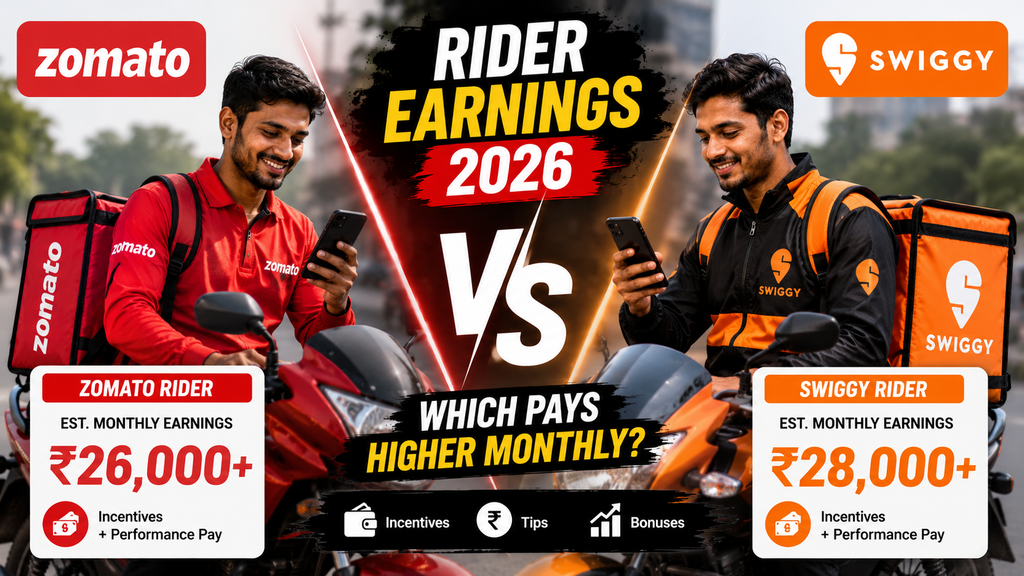
The multi-billion-dollar food delivery duopoly between Zomato and Swiggy continues to dominate India’s urban landscape in 2026. For hundreds of thousands of gig workers, choosing between the red t-shirt of Zomato and the orange badge of Swiggy is the single most important career decision. With both platforms processing millions of restaurant orders daily, prospective riders constantly evaluate zomato vs swiggy rider earnings to determine which company offers superior monthly take-home income.
While both aggregators operate on dynamic algorithmic rate cards—factoring in base pay, distance multipliers, restaurant waiting charges, and surge bonuses—their milestone incentive structures and peak-hour rules differ markedly. A rider working a 10-hour full-time shift on Zomato might experience higher weekend dinner bonuses, while a Swiggy delivery executive might benefit from unified grocery pod batching during dull afternoon hours.
In this exhaustive 2026 head-to-head financial audit, we compare real rate cards, daily order volumes, fuel consumption ratios, weekly milestone bonuses, and customer tipping trends across Tier-1 and Tier-2 cities to crown the ultimate earnings champion.
Base Rate Card & Distance Pay: Zomato vs Swiggy
Let us examine how the baseline algorithmic compensation models compare on the ground:
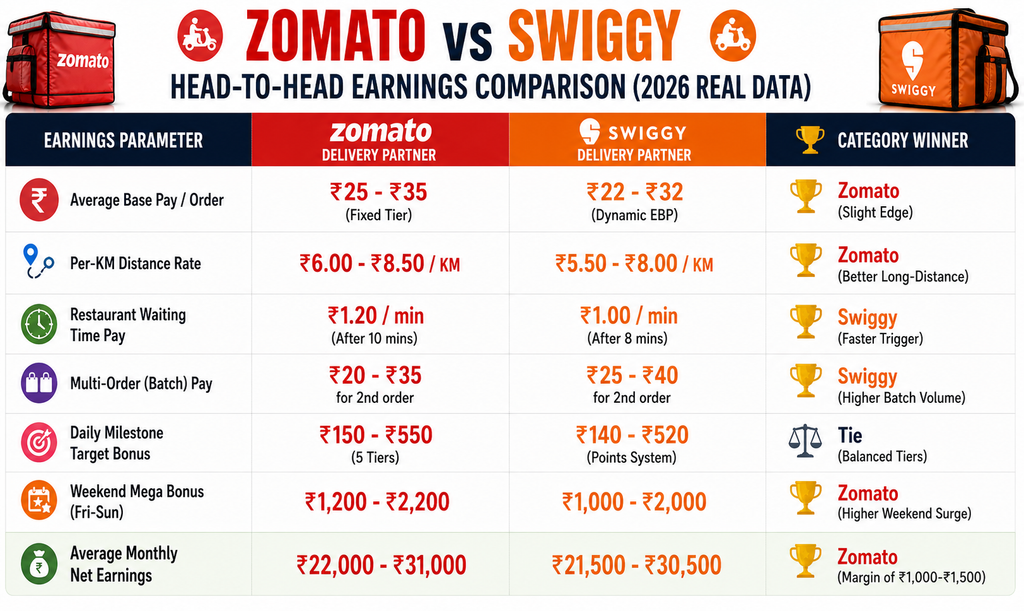
- Zomato Base & Touchpoint Model: Base pay starts between ₹25 and ₹35 for the first 2 km, with additional distance pay ranging from ₹6.00 to ₹8.50 per km. Zomato offers lucrative return pay on long-distance deliveries exceeding 7 km.
- Swiggy Effort-Based Pay (EBP): Calculates pay dynamically using estimated travel time, distance, and real-time merchant wait times. Base pay averages ₹22 to ₹32, with ₹5.50 to ₹8.00 per km thereafter, supplemented by robust multi-order batching fees.
Head-to-Head Earnings Comparison Table (2026 Real Data)
> Compare active delivery partner vacancies across Zomato, Swiggy, and leading logistics networks in your city. Find the highest-paying local hubs today.
Incentive Mechanics & Touchpoint Systems
Both platforms enforce strict algorithmic rules to unlock daily target payouts. According to research on gig work compensation by NITI Aayog, incentive attainment depends on shift consistency:
Zomato Gigs / Slot Booking: Riders must pre-book specific 2-to-4 hour ‘Gigs’. Completing booked gigs with 95%+ order acceptance triggers direct cash milestone bonuses without complex point conversions.
Swiggy Target Points System: Orders earn variable ‘points’ based on order size, rain intensity, and midnight hours. Accumulating 100 to 220 points daily unlocks tiered daily cash bonuses.
Fuel Efficiency & Net Take-Home Reality
Gross payouts do not tell the whole story. A full-time delivery partner traveling 90 km daily incurs significant operating overheads:
- Zomato Daily Fuel Cost: Roughly ₹220–₹270/day due to longer cross-suburb deliveries.
- Swiggy Daily Fuel Cost: Roughly ₹180–₹230/day when operating near high-density Instamart and restaurant clusters.
- Net Monthly Margin: While Zomato delivers higher gross earnings during weekend dinner surges, Swiggy riders balance out net take-home pay by burning less fuel during afternoon grocery batches.
Pros and Cons: Which App Should You Choose in 2026?
Choose Zomato If: You prefer long-distance deliveries with high per-kilometer returns, enjoy weekend dinner rushes, and value straightforward milestone targets.
Choose Swiggy If: You prefer hyper-local cluster deliveries, want access to both restaurant orders and Instamart grocery shifts on a single app, and prefer faster waiting time compensation.
Frequently Asked Questions (FAQs)
Which company gives more orders: Zomato or Swiggy?
Order frequency varies by locality. In commercial IT zones and premium residential sectors, Zomato holds a slight lead in restaurant food orders, while Swiggy provides higher order density when combined with Instamart grocery deliveries.
Can a delivery partner work for both Zomato and Swiggy simultaneously?
Yes. Many experienced gig workers carry dual partner IDs, switching between apps during different shift windows (e.g., Swiggy for afternoon groceries and Zomato for evening dinner surges).
Which app has a lower joining fee in 2026?
Both platforms require a nominal onboarding kit deposit (₹500 to ₹1,200 for bags and t-shirts), which is typically deducted in small weekly installments from your first few payouts.
How much petrol money is spent monthly on Zomato and Swiggy?
A full-time rider traveling 80–100 km daily spends between ₹5,000 and ₹7,500 per month on petrol for standard 110cc motorcycles.
Are tips higher on Zomato or Swiggy?
Customer tipping trends are slightly higher on Zomato during late-night weekend meal orders and festive party celebrations.
> Maximize your monthly delivery income with top food delivery fleets offering daily incentives. Submit your quick application and start delivering this week.
Conclusion
In the ultimate head-to-head battle of 2026, Zomato takes a slight lead in pure dinner rush payouts and weekend surge pay, while Swiggy offers greater consistency through Instamart batching. Your ultimate monthly income will depend on your local hotspot density, shift discipline, and route efficiency.

